
You start planning a trip with excitement. Then the tabs multiply.
Flights. Hotels. Reviews that contradict each other. A restaurant list from a blog you half trust. A map full of pins. Before long, the getaway you wanted starts to feel like a part-time job.
That is usually when the real question appears. Why use a travel agent when everything is online? Because access is not the same as clarity. A great travel advisor does more than book. They filter the noise, protect your time, and shape a trip that actually fits how you want to travel.
La Sirena Vacations is a boutique travel company offering private guided tours and customized experiences. Their work goes far beyond making reservations. It is about authentic cultural encounters, hidden corners you would likely miss alone, and thoughtfully built travel with heart and soul.
Table of Contents
- The Modern Traveler's Dilemma
- Beyond Bookings The True Value of a Travel Advisor
- The Human Touch Versus The Algorithm
- Journeys With Heart Real-World Examples
- The Cost of a Trip Versus The Value of an Experience
- Choosing Your Travel Partner How to Find the Right Agent
- Your Journey With La Sirena Vacations What to Expect
- Frequently Asked Questions
The Modern Traveler's Dilemma
A couple planning an anniversary trip to Spain once started with a simple goal. They wanted good food, a beautiful hotel, and a few days that felt personal instead of touristy. By the second evening of planning, they had too many choices and no confidence in any of them. Every hotel looked polished. Every neighborhood claimed to be “authentic.” Every article promised hidden gems, many of which were no longer hidden at all.
That's the modern traveler's dilemma. Digital tools give access, but they rarely give clarity. The internet can show you everything and still leave you unsure what matters.
For a meaningful trip, that uncertainty gets expensive. The wrong flight connection can unravel the first day. The wrong hotel can flatten the mood of the whole week. The wrong location can turn a romantic escape into a commute.
Practical rule: The more emotional, expensive, or logistically layered a trip is, the more valuable judgment becomes.
That's one reason travel advisors remain so relevant. In 2023, travelers booked 70% of their long-haul trips through a travel advisor, and the same Internova-backed industry outlook summarized by Host Agency Reviews notes a projection that the agency share of the total U.S. travel market will rise to 26% in 2026 from 21% in 2022. That tells a clear story. When the trip matters, people want a human being in the room.
The calm in the middle of the planning storm
A strong advisor acts like an editor. Not of words, but of possibilities. They cut the noise. They know which gorgeous properties are style over substance, which routes look efficient on paper but feel punishing in practice, and which experiences are worth rearranging a day for.
That's the hidden answer to why use a travel agent. You're not hiring someone to click “confirm.” You're choosing someone to protect the feeling of the trip before the trip even begins.
For travelers who care about meaning, not just movement, that distinction changes everything.
Beyond Bookings The True Value of a Travel Advisor
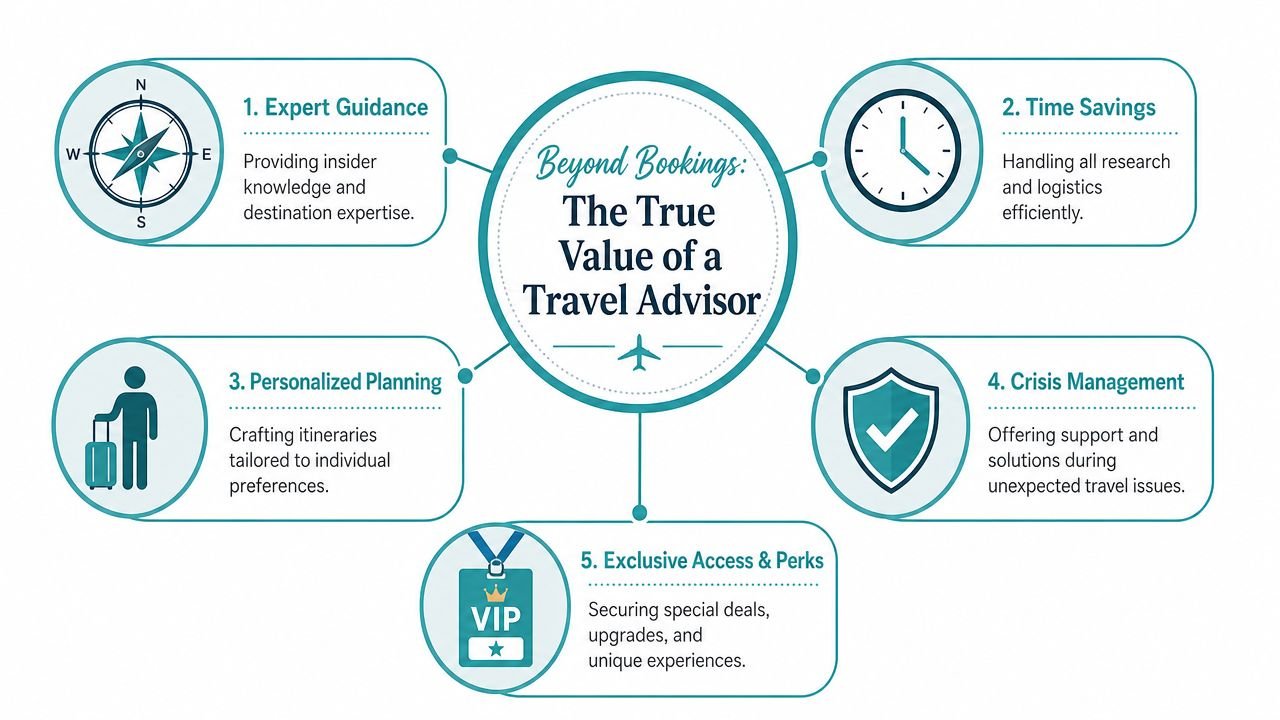
A travel advisor is closer to an architect than a ticketing desk. You can buy a prefabricated house and move in quickly. Or you can work with someone who studies the land, the light, how you live, and what you want to feel when you walk through the door. Travel works the same way.
The strongest advisors bring four forms of value that booking sites can't fully replicate. They offer destination expertise, access, personalization, and support when plans wobble.
A good advisor reads between the lines
Sometimes a traveler says, “We want to see a lot.” What they really mean is, “We don't get much time off, and we want this to count.” Another says, “We love food.” What they may mean is, “Please don't send us anywhere built for selfies instead of flavor.”
That interpretation is the craft.
According to a 2024 ASTA survey cited by Condor Ferries, the top reasons people choose a travel agent are ease of booking (54%), support if something goes wrong (43%), and time saved (43%). The same summary notes that 50% of travelers are more likely to use an agent today than in the past. Those aren't abstract preferences. They map directly to what people need.
- Expertise: An advisor knows the difference between a famous destination and a good fit.
- Access: Some experiences never surface on big booking platforms in a useful way.
- Personalization: A trip can match your pace, your appetite, your energy, your reason for going.
- Support: If something shifts, you're not left negotiating alone with automated systems.
- Time protection: Hours of research collapse into a smaller set of smart choices.
A curated travel company's custom planning services often show this best. The value isn't more options. It's better options.
What that support looks like in real life
A well-designed itinerary has rhythm. It knows when to leave space. It doesn't stack the three most demanding experiences on consecutive days and call that efficiency. It protects your energy as carefully as your budget.
A booking engine can sort by price or popularity. It can't tell that your parents need shorter walking distances, that your team will bond better over a private dinner than a packed group tour, or that your anniversary deserves a room with silence more than square footage.
That's why the question isn't whether websites are useful. They are. The question is whether useful is enough for a trip you'll remember for years.
The Human Touch Versus The Algorithm
Online booking tools are good at volume. They collect listings, sort rates, and present filters that make planning feel manageable for a while. If you already know exactly what you want, that convenience can be appealing.
But travelers often confuse access to inventory with access to insight.
DIY gives options. An advisor gives shape
When you plan alone, you do more than choose hotels and flights. You also become the researcher, scheduler, quality controller, and emergency contact. That can work for a simple weekend. It gets heavier when the trip includes multiple destinations, special experiences, family dynamics, corporate expectations, or unfamiliar regions.
Here's the difference at a glance.
| Feature | DIY Planning (Online Booking Sites) | With a Travel Advisor (like La Sirena Vacations) |
|---|---|---|
| Personalization | Based on filters, reviews, and your own research | Built around your travel style, priorities, and purpose |
| Time Investment | High. You compare, verify, map, and cross-check | Lower. The advisor narrows choices and handles logistics |
| Access to Perks | Mostly public offers and widely promoted experiences | Better access to negotiated benefits, insider experiences, and thoughtful extras |
| Problem Solving | You handle delays, changes, and supplier communication | A real person helps untangle issues and advocate for you |
| Overall Value | Can look cheaper upfront but may hide trade-offs | Focuses on fit, ease, and a smoother experience from start to finish |
The algorithm doesn't know what matters most to you. It can't recognize that your group needs a hotel lobby suitable for informal meetings, or that one extra transfer will leave young children exhausted before dinner.
It also can't warn you when a “perfectly located” property sits on the loudest street in the neighborhood, or when a day trip that looks magical online is too rushed to be enjoyable.
- DIY works best when the trip is simple, stakes are low, and you enjoy doing the research.
- An advisor works best when the details affect comfort, mood, money, or once-in-a-lifetime moments.
- A specialist matters most when destination knowledge changes the quality of what you experience, not just where you sleep.
That's the quiet strength of the human touch. An experienced advisor uses intuition, memory, supplier relationships, and listening. An algorithm processes inputs. A person understands context.
Journeys With Heart Real-World Examples
A leadership team lands in Riga after months of planning. Nobody is texting about airport pickups. Nobody is hunting for the meeting room. The welcome dinner starts on time in a candlelit space that feels unmistakably local, and by the second course, people have stopped talking about logistics and started having the conversations the retreat was built for.

A Baltic retreat that runs without friction
Corporate retreats in the Baltic States ask for more than a hotel block and a spreadsheet. They need well-timed arrivals, rooming accuracy, meeting spaces that feel polished without feeling sterile, and enough local texture to make the trip memorable after the agenda ends.
A skilled advisor handles the trip as a whole composition. Flights, transfers, dietary notes, pacing, private guides, backup plans, and the small human details that change the mood of a group all have to fit together.
The finished experience feels calm because the hard work happened earlier. Guests move from airport to hotel without confusion. The schedule has breathing room. A walking tour through the old town lands at the right hour, not in the middle of the workday. Dinner feels chosen, not assigned.
That is the difference between a booking service and a travel artisan. One reserves components. The other shapes the atmosphere of the trip.
A Valencia escape built around flavor
A couple flying to Valencia for an anniversary rarely wants a rushed checklist. They want the city to open slowly. Coffee in a sunlit square. A market visit with someone who can explain why one stall has a line and another does not. A vineyard afternoon that feels intimate. A dinner where the room hums with local conversation.
That kind of trip begins with better questions.
Do they want late nights or quiet evenings? A grand historic hotel or a smaller stay on a calmer street? One theatrical tasting menu, or three satisfying neighborhood meals? Those answers shape the story of the trip far more than a list of attractions.
The best itineraries leave room for appetite, serendipity, and the pleasure of arriving somewhere at the right pace.
For travelers dreaming about Europe, that same kind of pacing matters across the whole journey, not just one city. This guide on how to plan a vacation to Europe with the right rhythm and priorities can help you see how the pieces fit together.
A good advisor curates Valencia with intention. A great one notices that the couple loves food but hates feeling rushed, then builds days that let flavor, conversation, and place unfold naturally. That is how a celebration starts to feel personal.
A short look at the mood of customized travel helps bring that to life:
Patagonia for a family that wanted wonder not chaos
Patagonia can be breathtaking and exhausting in the same breath. Distances are long. Weather changes quickly. A family may dream about glaciers, horseback rides, and wide-open spaces, then discover that one poorly timed transfer can drain the joy from an entire day.
The families who come home happiest usually do not have the fullest itineraries. They have the best-shaped ones.
A travel advisor with real destination knowledge might place two active days apart instead of back to back. They might choose a lodge with warmth and character over one that looks impressive online but feels formal with children. They might arrange a guide who knows when to keep talking and when to let the scenery do the work.
The glacier becomes the photograph everyone keeps. The smaller moments become the memories they tell. Hot chocolate waiting after a windy excursion. A driver who already knows who gets carsick. An extra unscheduled hour that lets the children throw stones in the water while the parents look around and breathe.
Those details are not decorative. They are the trip.
That is what a storycrafter does. They do not just book Patagonia. They shape a family's experience of awe so it feels joyful, grounded, and entirely their own.
The Cost of a Trip Versus The Value of an Experience
Many travelers hesitate for one reason first. Cost. They assume using an advisor adds expense and that booking independently is always the leaner option.
Sometimes that assumption hides a narrower problem. People focus on the cost of purchase instead of the value of the whole trip.

Cheap and valuable are not the same thing
A low room rate can become poor value if the property is badly located, stressful, or stripped of the details that make a stay restorative. The cheapest itinerary can cost more in time, energy, and missed opportunities than a better-planned one.
Travel advisors are paid in different ways depending on the trip. Some work through commissions from suppliers. Some charge planning fees. Some do both. What matters for the traveler is transparency and the quality of what that payment provides.
That value can include better-fit hotels, meaningful experiences, more efficient routing, help avoiding costly mistakes, and access to benefits that aren't obvious during a quick search. If you're planning Europe and want to think more clearly about pacing, priorities, and where value really sits, this guide on how to plan a vacation to Europe is a useful companion.
Why advisors matter on smaller budgets too
One of the most overlooked truths in travel is that advisors aren't only for luxury trips. They can also be smart for budget-conscious travelers who want to spend carefully and still travel well.
A travel planning analysis from Best Version Media notes that 61% of travelers prioritize personalized recommendations for hidden gems, and frames this as a reason advisors can deliver better value through exclusive deals and time-saving expertise, including on smaller-budget trips.
That rings true in practice.
- Better local judgment: A modest hotel in the right area can outperform a flashy one in the wrong area.
- Smarter spending: A private guide for one half-day may create more value than three mediocre paid activities.
- Less waste: An advisor can steer you away from overpacked itineraries that burn money without adding joy.
- Higher return on time: You spend less time untangling logistics and more time being present.
Worth remembering: A good advisor doesn't try to make every trip expensive. They try to make every decision count.
That's the stronger way to think about price. Not “What is the cheapest way to go?” but “What will make this trip feel worthwhile?”
Choosing Your Travel Partner How to Find the Right Agent
Not every travel advisor works the same way. Some are broad generalists. Others know a handful of regions intimately and build journeys with far more texture because of it. If your trip matters, specialization matters too.
What to look for before you commit
Start with fit, not polish. A beautiful website won't tell you whether someone listens well, asks sharp questions, or understands the difference between a generic itinerary and a personal one.
Look for these signals:
- Destination depth: Choose someone who knows your region well, especially if your trip includes culture, food, nature, or moving parts that need careful pacing.
- Curiosity about you: A strong advisor asks why you're traveling, not just when and where.
- Clear communication: You should know how they work, how they charge, and how they handle support.
- Taste and judgment: Their recommendations should feel edited, not copied from a list of popular spots.
- Boutique mindset: Smaller, high-touch agencies often offer more personal collaboration than volume-driven booking operations. This overview of a boutique travel agency approach shows what that style can look like.
A short conversation usually tells you a lot. If the advisor rushes into inventory before understanding your priorities, keep looking. The right partner won't just plan your trip. They'll understand what you want the trip to mean.
Your Journey With La Sirena Vacations What to Expect
With La Sirena Vacations, the process begins with listening. Not a generic intake form treated like a transaction, but a real conversation about what you're drawn to, how you like to travel, who's coming with you, and what would make the journey feel memorable in the right way.
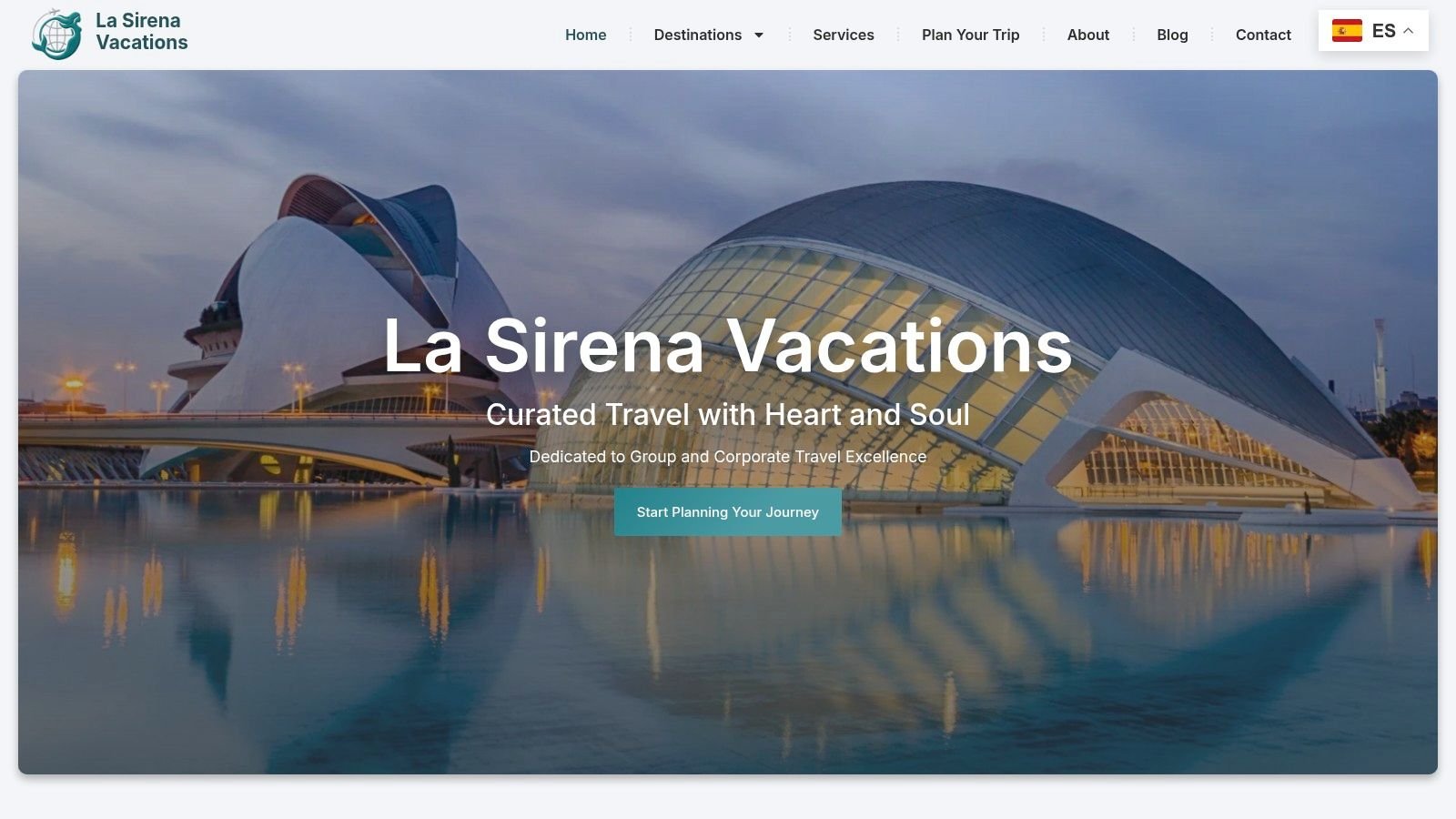
From there, the itinerary takes shape around you. That might mean private guided touring, custom cultural experiences, carefully chosen hotels, culinary moments that feel rooted in place, or a group program designed to run smoothly without losing its humanity. Spain, Argentina, and the Baltic States each ask for different instincts, and a boutique specialist can respond with nuance rather than templates.
Group travel is a good example of what that care looks like. According to Vincent Vacations' overview of group travel planning, advisors can secure exclusive negotiated rates and perks like free rooms for group leaders, while careful reading of vendor fine print helps avoid mismatched expectations and preserve value across the whole group.
That same spirit carries through the booking stage and the trip itself. You're not handed a stack of confirmations and wished good luck. You have structure, clarity, and support from real people who know the plan and understand the stakes.
The result is a different feeling entirely. Less friction. More confidence. More room to notice the things you traveled for in the first place.
Frequently Asked Questions
Do travel agents only make sense for luxury trips
No. They're often especially helpful when you want to spend carefully. A good advisor can help you avoid weak-value choices, focus on experiences that matter most, and find places with character instead of paying for hype.
What if I already know where I want to go
That's a great starting point. An advisor doesn't need to replace your ideas. They refine them. If you know the destination but not the best neighborhood, pacing, hotel, guide, or experience mix, expert curation still adds a lot.
Are travel agents useful for groups
Very much so. Groups create moving parts that multiply quickly. Different arrival times, room types, dietary needs, shared events, payment timing, and communication all become easier when one experienced person is coordinating the whole structure.
Will I lose control over my trip
No. The best advisor relationship is collaborative. You're not giving up authorship. You're working with someone who can edit, enhance, and protect the trip from weak decisions. You still choose. You just choose from better options.
A strong travel advisor doesn't make the trip less yours. They make it more so.
If you've been wondering why use a travel agent, the simplest answer is this: because some journeys deserve more than efficient booking. They deserve care, judgment, and a human hand shaping the experience from the first conversation to the flight home.
If you're ready for a trip that feels personal from the first idea to the final day, explore La Sirena Vacations. Their boutique approach to private guided tours and customized travel in Spain, Argentina, and the Baltic States is built for travelers who want more than logistics. They want meaning, hidden gems, and a journey with heart and soul.