
You're probably reading this with a browser full of tabs. One promises “must-see highlights.” Another offers a luxury coach and a checklist of landmarks. A third has beautiful photos but says nothing about how the trip will feel once you arrive. And if you've traveled enough, you already know the uneasy truth. A polished itinerary can still leave you oddly untouched.
Most travelers who come to small group tours arrive there after disappointment. They've stood in a cathedral while someone with a flag hurried them toward the exit. They've eaten at the “included local restaurant” that was clearly built for volume, not memory. They've looked around a crowded bus and realized they were seeing a country without ever meeting it.
The difference with traveling small isn't just logistics. It's emotional. It's the pause long enough to hear a shopkeeper explain which olive oil came from her family grove. It's a guide who notices your fascination with old tiles and makes a subtle adjustment to the afternoon so you can step inside a workshop. It's the sense that a journey still has room for surprise.
Table of Contents
- The Search for Something More in Travel
- What Are Small Group Tours Really
- The Heart and Soul of Traveling Small
- Finding Your Perfect Fit in a Small Group
- Curated Journeys A World of Difference
- Planning Your Personalized Small Group Tour
- Your Questions Answered and The Journey Ahead
The Search for Something More in Travel
A CFO once described her last grand European tour to me over coffee in an airport lounge. The hotels were immaculate. The drivers arrived on time. Every museum on the wish list was checked off. Yet what stayed with her was not Florence or Vienna or Prague. It was the feeling of being hurried from one polished moment to the next, always surrounded, rarely present, watching each city through glass.
She said the trip gave her proof she had been there, but almost no sense of having belonged there.
I have heard versions of that story from honeymooners, founders planning executive retreats, and solo travelers who can afford the finest addresses in the world but still come home strangely underfed. Travel can be perfectly arranged and still miss the part we ache for. The pause at a long lunch when a winemaker pulls up a chair. The unscripted conversation with a guide who notices what interests you. The relief of not feeling processed.
That longing has shaped the rise of small group travel. Analysts project the global small group tour market to be valued at $68.4 billion in 2025 and to reach $138.7 billion by 2034, with continued growth through that period. The numbers matter because they reflect a wider shift in what experienced travelers are asking for. Less spectacle. More meaning. Less crowd management. More contact.
Travel changes when you stop moving through a place as inventory and start moving through it as a guest.
For discerning travelers, especially those planning high-touch leisure trips or corporate journeys with real relationship value, that difference is everything. A well-crafted small group experience creates room for recognition. People remember one another's names. Hosts have time to notice preferences. A day can bend gently toward curiosity instead of marching to a script.
That is the part large-format travel rarely gives you. Not access alone, but intimacy. Not efficiency alone, but memory. Travel designed for anything but the soul leaves very little behind.
What Are Small Group Tours Really
On the first morning of a Sicily itinerary I designed for a leadership group, twelve travelers met over coffee and warm brioche in a quiet piazza. By lunch, the guide knew who cared about baroque architecture, who wanted to linger over seafood, and who needed a slower walking pace after an overnight flight. This is the core definition of a small group tour. A journey scaled so people can be individually seen.
Formally, a small group tour is a guided travel experience designed for a limited number of participants, often anywhere from 2 to 20 guests. In practice, many of the best itineraries feel even more intimate than that number suggests, because the group is shaped around shared interests, thoughtful pacing, and places that welcome conversation instead of crowd control.
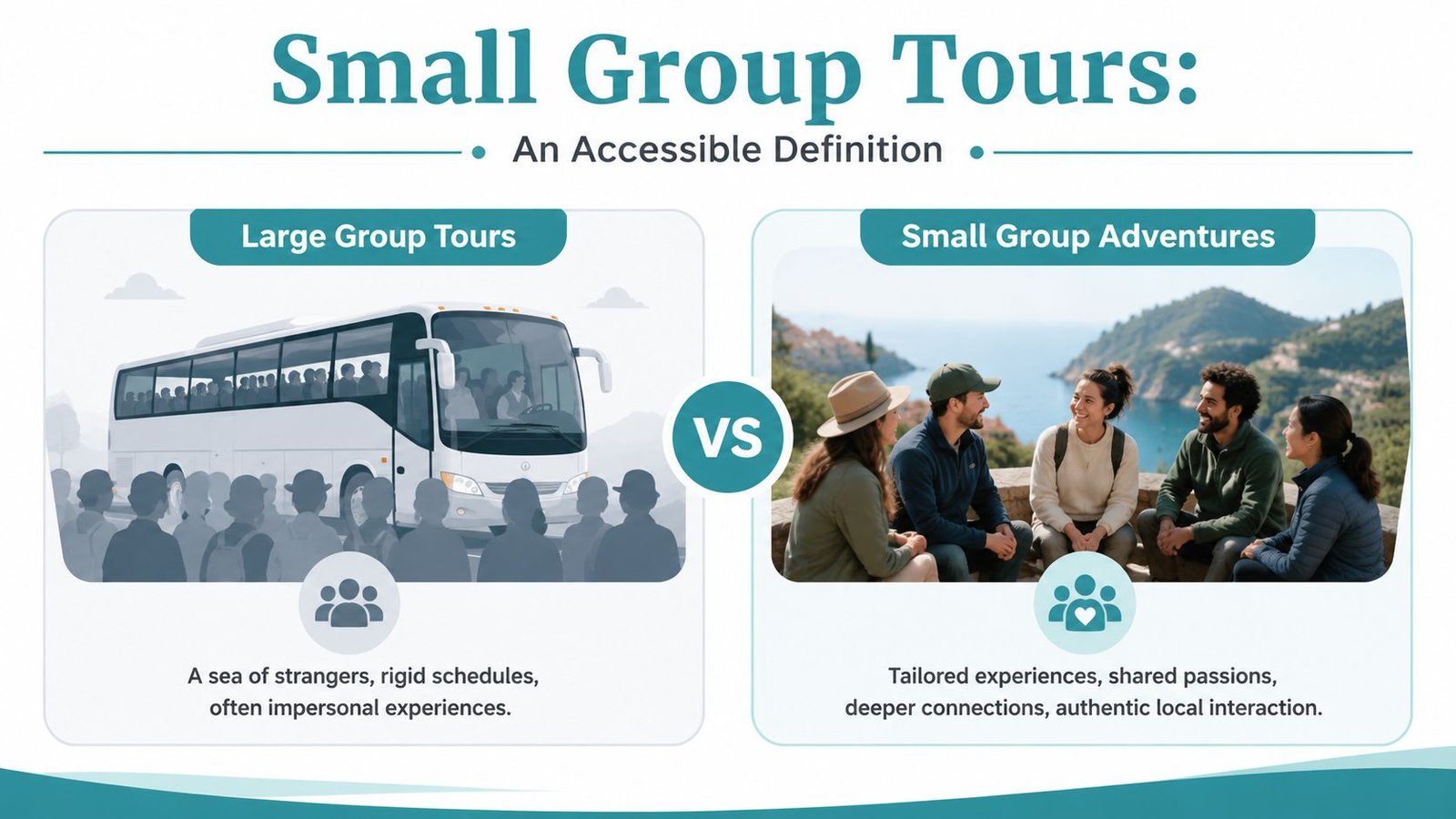
Size changes the experience in ways that are immediate. A guide can adjust the tempo without throwing off a busload of people. A museum visit can turn into an exchange instead of a lecture. A host can set one long table in a family dining room, pour another glass, and tell the story behind the recipe because the room still feels human.
That is why small group tours sit in a distinct place on the travel spectrum.
| Travel style | Typical feel | Best for |
|---|---|---|
| Large group tour | Fixed pace, broad access, less personal interaction | Travelers focused on major highlights and efficiency |
| Small group tour | Shared journey, flexible rhythm, stronger guide connection | Travelers who want both community and depth |
| Private trip | Fully customized, fully private, often highest-touch | Travelers who want complete control and privacy |
For many luxury and corporate travelers, that middle ground is unusually rewarding. Private travel offers privacy. Large escorted travel offers scale. Small group travel gives something more nuanced. It creates enough intimacy for genuine connection, while keeping the pleasure of a shared table, a good conversation after dinner, and the subtle chemistry that comes from discovering a place alongside a few well-matched fellow travelers.
A well-crafted small group journey also opens doors that larger formats often cannot. I have seen a ceramics artist in Puglia invite a group into the back workshop because there were only ten of us. I have watched an executive team in Kyoto stop for an unplanned tea with their guide after a temple visit sparked a conversation about ritual and attention. Those moments rarely happen because an itinerary promised them. They happen because the group is small enough to make room for them.
Practical rule: If you want conversation, flexibility, and time in places that still feel lived-in, small group tours usually offer the best balance.
The label alone does not guarantee that feeling. Some departures are highly structured, others feel close to a private journey with a few like-minded companions. The difference comes down to curation. Group size matters, but the key measure is whether the trip leaves space for recognition, spontaneity, and the kind of access that feels personal rather than performed.
The Heart and Soul of Traveling Small
Why the format changes the feeling
The magic of small group tours isn't found in the vehicle size. It's found in what that smaller footprint allows.
A guide can linger when something catches the group's attention. A chef can step out of the kitchen and explain the dish. A winemaker can pour from a bottle that isn't part of a formal tasting menu because the setting still feels personal. The day breathes differently. Instead of racing from one confirmed stop to the next, you begin to notice the unplanned moments that often become the memory.
That flexibility matters because travelers increasingly want journeys that bend toward their interests. Well over half of small group customers now request at least one bespoke component in their trip, such as an optional activity, an upgraded meal, or an added night, according to The Traveler's reporting on smaller groups and personalization.
Herein lies the soul of the format:
- Shared meals with shape and texture. Not just eating near one another, but trading stories, asking questions, and letting a place reveal itself over a slow lunch.
- Guide relationships that deepen quickly. In a smaller setting, a guide notices who loves architecture, who wants extra museum time, who lights up in markets, and who needs a gentler pace.
- Access that feels less staged. Home-hosted dinners, village walks, and small producer visits work because the scale remains respectful and manageable.
- Spontaneity. A roadside stand with perfect fruit. A festival procession turning into a detour. An extra half hour because the conversation in a workshop became too good to cut short.
The honest trade-offs
Small doesn't automatically mean perfect. It means different.
A boutique journey may cost more than a mass-market tour. You're paying for nimbleness, curation, and access, not just transport and room nights. You're also sharing space with other people, which means chemistry matters. The right group can feel like a serendipitous dinner party. The wrong one can make every breakfast feel slightly off.
There's also an ethical layer that thoughtful travelers shouldn't ignore. Smaller groups often reach places large tours can't, but intimacy alone doesn't guarantee innocence. In fragile communities, even a modest group can alter the atmosphere if regional visitor volume rises too fast. Undiscovered Destinations' discussion of small groups and cultural access points to that nuance, especially in hyper-local settings where even small numbers can contribute to touristification.
The best small group travel doesn't only ask, “Can we get in?” It asks, “Should we be here, and how do we show up well?”
That question is part of the philosophy. Good travel should leave you with deeper connection, not just better photos.
Finding Your Perfect Fit in a Small Group
A small group journey can feel completely different depending on who's traveling and why. A group of cyclists crossing dramatic terrain needs a different rhythm than executives gathering for an off-site or a couple celebrating an anniversary with wine, art, and long lunches.
For the solo adventurer
Solo travelers often want two things at once. Independence and relief. They want to arrive without needing to engineer every transfer, permit, and piece of equipment themselves.
That's where the format becomes especially powerful. Small group tours for 8 to 16 people are a logistical and economic key for solo adventurers, enabling access to high-tech activities like guided glacier hiking or cycling that are often impossible or prohibitively expensive for individuals due to equipment and guide costs, as noted in Travel And Tour World's discussion of small group travel for adventure access.
For this traveler, a small group isn't a compromise. It's often the only elegant way to do the trip they want.
For couples and private-minded travelers
Couples usually come to small group tours when they want intimacy without the pressure of designing every detail themselves. They want someone else to open the hidden door, reserve the private tasting, manage the timing, and still leave enough room for a stolen hour in a café or a walk at dusk.
Micro-groups often suit them best. A group of four to eight tends to feel hushed, flexible, and finely tuned. A standard small group of twelve to sixteen can still work beautifully if the itinerary favors atmosphere over volume.
A quick guide helps:
| Traveler profile | Best small group feel | Why it works |
|---|---|---|
| Solo adventurer | 8 to 16 travelers | Shares logistics, guides, and specialized access |
| Couple | 4 to 8 travelers | More privacy, softer pacing, easier personalization |
| Friends or family | Private or 6 to 10 travelers | Keeps the journey social but cohesive |
| Executive retreat | 6 to 12 travelers | Supports discussion, service, and custom moments |
For corporate and executive groups
Corporate planners often need more than a good itinerary. They need trust. They need to know the dinner will start on time, the transfer will be smooth, dietary needs won't be forgotten, and the cultural programming will feel refined rather than generic.
This is why the semi-FIT model has gained traction. According to DMCQuote's guide to FIT and GIT packages, the semi-FIT small group format for 6 to 12 travelers is the fastest-growing post-COVID segment, with the 8 to 12 traveler range described as a sweet spot between social energy and intimacy. For executive teams, that balance is gold. The group is large enough to create shared memory and discussion, but small enough to preserve discretion, quality, and flow.
Curated Journeys A World of Difference
An evening outside Valencia
By the time the car leaves Valencia behind, the city has already loosened its grip. Orange groves catch the last light. Low stone walls hold the warmth of the day. At a country home beyond the outskirts, a host waits in the courtyard with saffron, green beans, crushed tomatoes, and a wide black pan set over the fire.
A group of six settles in naturally. One guest asks why bomba rice behaves differently in the pan. Another slips into the garden with a glass of local wine. The host pauses to tell a story about Sunday lunches that stretch well past sunset, and the lesson becomes something gentler than instruction. It feels like being welcomed into a ritual.
That intimacy shapes the journey as much as the destination. Details such as staffing, access, and the kind of private experiences that work best for smaller parties are part of La Sirena's luxury destination travel guidance. The point is not logistics for their own sake. The point is protecting the mood of the evening, so dinner still feels like dinner, not a scheduled event.
A tango salon in Buenos Aires
Buenos Aires reveals itself by degrees. First the coffee. Then the worn marble steps. Then the polished wood floor of a historic salon, where the room grows quiet just before the bandoneon begins.
I have always loved what happens when a small group enters a space like this with the right size and the right tone. The teacher notices everyone. A hand is adjusted lightly at the shoulder. A pause in the music becomes part of the lesson. No one fades into the back row, because there is no back row. There are only a few couples, a watchful instructor, and the strange thrill of realizing tango is less performance than conversation.
Some experiences lose their meaning once the room gets crowded. Tango is one of them.
As noted in La Sirena Vacations' destination guidance, many of the most atmospheric venues in Buenos Aires keep groups intentionally intimate. That choice preserves the exchange itself. Luxury travelers feel it immediately. Corporate groups feel it too, especially when the goal is not entertainment alone, but shared memory with texture and grace.
Quiet trails in the Baltics
The Baltics offer a different kind of privilege. Silence. Pine forests breathing resin into cool air. Boardwalks crossing marshland where the reeds move before you hear the birds. Sea cliffs under a northern sky that keeps changing its mind.
On one custom journey, the group stopped walking without being asked. No phones. No chatter. Just the soft creak of timber beneath their shoes and a guide lowering her voice to point out tracks in the sand. In a larger party, that moment would have scattered. In a small one, it held.
La Sirena Vacations notes that nature access in parts of the Baltics is shaped by local permitting and conservation rules that favor smaller numbers. More important, the region feels better this way. Wildlife stays near. Conversation softens. The guide has room to respond to curiosity instead of managing noise.
That is the difference a curated small group journey makes. You do not just see more carefully chosen places. You experience them at a human scale, where connection has time to form and the destination still sounds like itself.
Planning Your Personalized Small Group Tour
The most successful journeys begin with better questions, not faster booking. If you're considering small group tours, especially at the luxury or executive level, the operator matters as much as the destination.
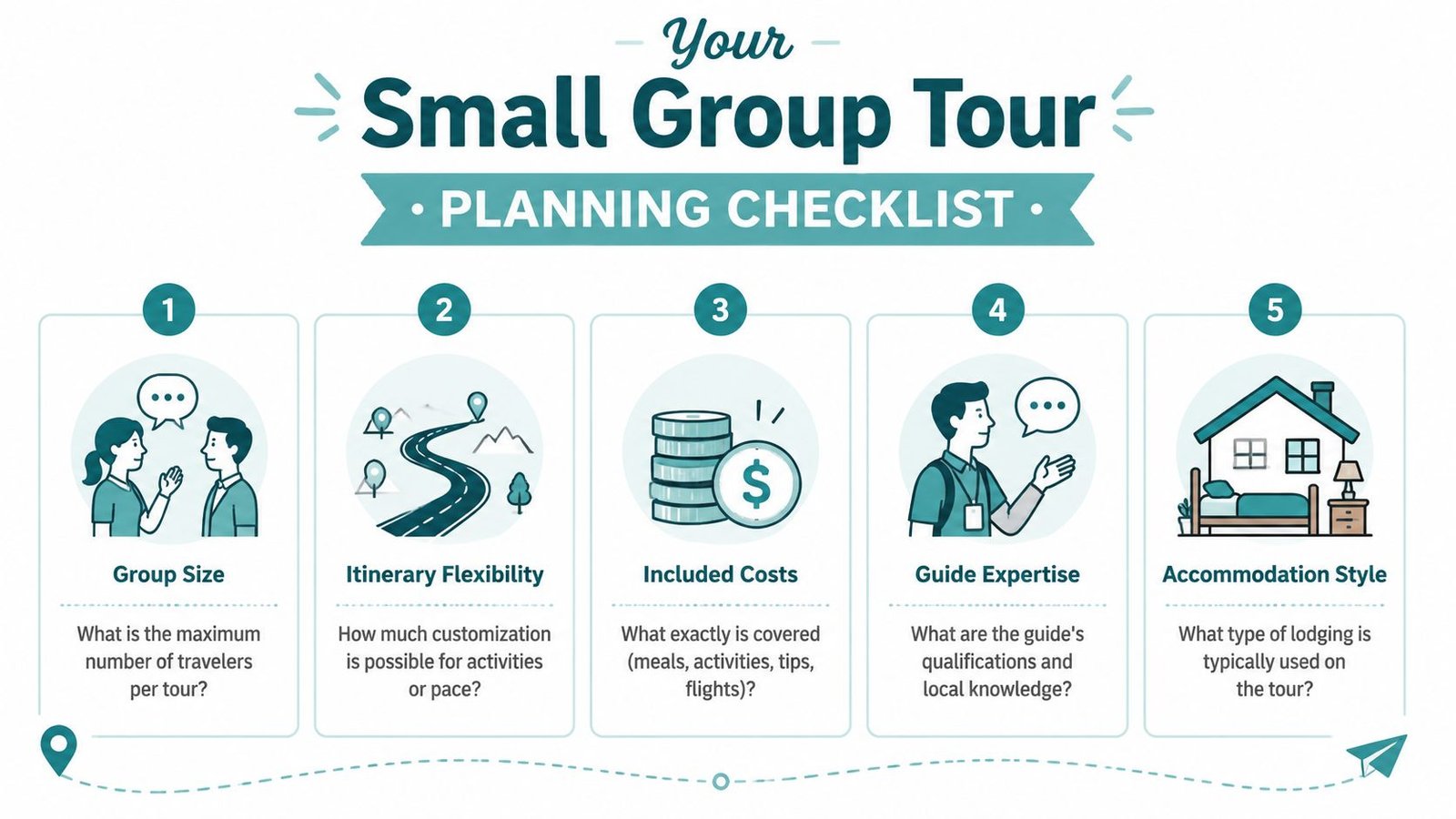
Questions worth asking before you book
A beautiful proposal can hide a rigid experience. Ask the practical questions early.
- Maximum group size. Don't settle for “small.” Ask for the actual cap.
- Flexibility on the ground. Can the pace shift if the group wants more time somewhere?
- What's included. Clarify meals, guide services, entries, gratuities, flights, and support.
- Guide depth. Ask who leads the trip and how their local expertise shows up in the itinerary.
- Accommodation character. A property can be elegant, generic, historic, or design-led. Those are different experiences.
For Europe-specific planning, a thoughtful primer like this guide to planning a vacation to Europe is useful because it forces the right discussions before the itinerary gets locked.
Why boutique pricing works differently
Travelers sometimes compare a boutique small group trip to a standard escorted tour and wonder why the gap is so wide. The answer is in the build.
Boutique small group tours for 6 to 10 travelers often cost 30 to 50% more than standard tours because they involve custom-built itineraries and hyper-personalized experiences, according to Pieter on Tour's analysis of boutique and small group travel.
That premium usually reflects things a spreadsheet doesn't capture well at first glance:
- Custom design instead of copying a fixed departure
- Exclusive access components such as private tastings or lesser-known visits
- Higher-touch service with more hands involved before and during the trip
- Founder or senior planner oversight in the most bespoke programs
Booking advice: If the trip costs more, ask what becomes possible because of that spend. Better access is a stronger answer than “better hotels.”
What luxury and corporate planners should clarify early
Luxury leisure travelers often focus on atmosphere. Corporate planners often focus on execution. Both should ask about support structure, contingency handling, dietary management, arrival choreography, and how the itinerary handles VIP expectations.
For a team retreat, the right operator should be able to build in moments that don't feel like obvious team-building. A private cooking experience can spark better conversation than a conference room breakout. A vineyard lunch can create more durable memory than another branded dinner.
The best small group tours feel effortless because someone sweated the details long before departure.
Your Questions Answered and The Journey Ahead
A short practical FAQ
How flexible are small group tours once the trip starts?
Usually more flexible than large-format touring, though not infinitely adaptable. The best ones build room for adjustments in pace, dining, and optional experiences without losing the structure that keeps the trip smooth.
Are small group tours suitable for travelers with mobility needs?
They can be, but suitability depends on the itinerary, terrain, and accommodation style. Ask for walking expectations, stair access, vehicle details, and how guides handle alternative pacing.
What about solo travelers and single supplements?
Policies vary. Some departures provide a smooth social experience for solo travelers, but rooming arrangements and supplement structures differ by operator. Ask early, especially if privacy matters to you.
Will I lose autonomy if I join a group?
Some autonomy, yes. You're joining a shared rhythm. But the right small group format gives you enough breathing room that the trade often feels worth it.
A good travel advisor can also help you decide whether a guided small group, a semi-private model, or a fully customized journey fits your style best. For many travelers, the case for using a travel agent becomes clearest when the trip involves moving pieces, exclusive experiences, or high expectations around service.
What stays with you after a great journey is rarely the checklist. It's the hand-rolled pasta served a little too late because the host kept talking. The forest path where everyone instinctively fell silent. The guide who understood what you were looking for before you found the words for it yourself.
That's the promise of small group tours at their best. Not more movement. More meaning.
If you're ready to plan a journey with depth, polish, and genuine cultural connection, La Sirena Vacations creates private guided tours and customized small group experiences with heart and soul across Spain, Argentina, and the Baltic States.