
You might be planning a trip right now with two browser tabs open and a mild sense of frustration. One tab shows glossy vineyard photos. The other lists a standard tour with a bus, a microphone, and a timetable that feels more like a school excursion than a holiday. What you want is simpler and harder to find. A table in a family-run bodega. A market stall owner who slips you a taste before the crowd arrives. A meal that explains a place better than any museum placard could.
That's why food and wine tours have such a pull. They don't just feed you. They translate a region through flavor, ritual, and conversation. The right journey lets you understand why a dish belongs to a coastline, why a wine tastes of a particular valley, and why a lunch can turn into the memory you carry home longest.
Table of Contents
- Beyond the Meal The Heart of Culinary Travel
- Understanding Your Options in Food and Wine Tours
- How to Design a Tour with Heart and Soul
- Navigating the Practical Details of Your Trip
- Curated Itineraries Inspiration for Your Journey
- The La Sirena Vacations Concierge Approach
- Your Culinary Travel Questions Answered
Beyond the Meal The Heart of Culinary Travel
The moment usually starts small. A cook sets down a plate you didn't know by name an hour earlier. The wine arrives in a simple glass, not a performance piece. Someone at the next table leans over to explain why that local bean, that coastal fish, that harvest festival matters here. Suddenly you're not consuming a destination. You're participating in it.
That shift is the essence of culinary travel. A good food and wine tour isn't about racing from tasting to tasting with a running scorecard. It's about entering the daily life of a place through its kitchens, vineyards, bakeries, and dining customs. You notice how people linger. You learn what gets served on ordinary Tuesdays, not just on camera-ready occasions.
This appetite for cultural connection isn't niche anymore. The global culinary tourism market was valued at USD $16.11 billion in 2025 and is projected to reach $76.36 billion by 2033, with food festivals accounting for 30.92% of the market. The numbers matter because they confirm something travelers already feel. More people want meals with meaning, not just reservations.
A meal can reveal a whole region
In one city, that might mean breakfast in a market where the cheese seller knows which farm each wheel came from. In another, it's a long lunch in wine country where the host talks as much about grandparents and weather as grape varieties. These moments don't feel staged when they're well designed. They feel like a door opened at the right time.
Food and wine tours work best when they slow you down enough to notice the people behind the plate.
There's also a difference between tasting and understanding. Anyone can sip. Fewer travelers get the context that turns flavor into memory. Why is a certain rice dish sacred on Sundays. Why does one village pour sparkling wine before lunch while another saves it for celebration. Why does a vineyard plant one row differently because of wind off the hills.
Why this style of travel stays with you
Cultural travel often becomes abstract. Culinary travel doesn't. It gives you texture, aroma, pace, and place. You remember the rough wooden table, the clay bowl, the scent of citrus in the courtyard.
That's why the best food and wine tours feel intimate even when they're carefully orchestrated. They don't flatten a destination into a highlights reel. They let you encounter its soul one bite, one pour, and one conversation at a time.
Understanding Your Options in Food and Wine Tours
Not every tour creates that kind of access. Some are built for efficiency. Some are built for sociability. Some are built around your pace, your taste, and your curiosity. Knowing the difference changes everything.
Here's a visual snapshot of the main formats travelers usually choose between.
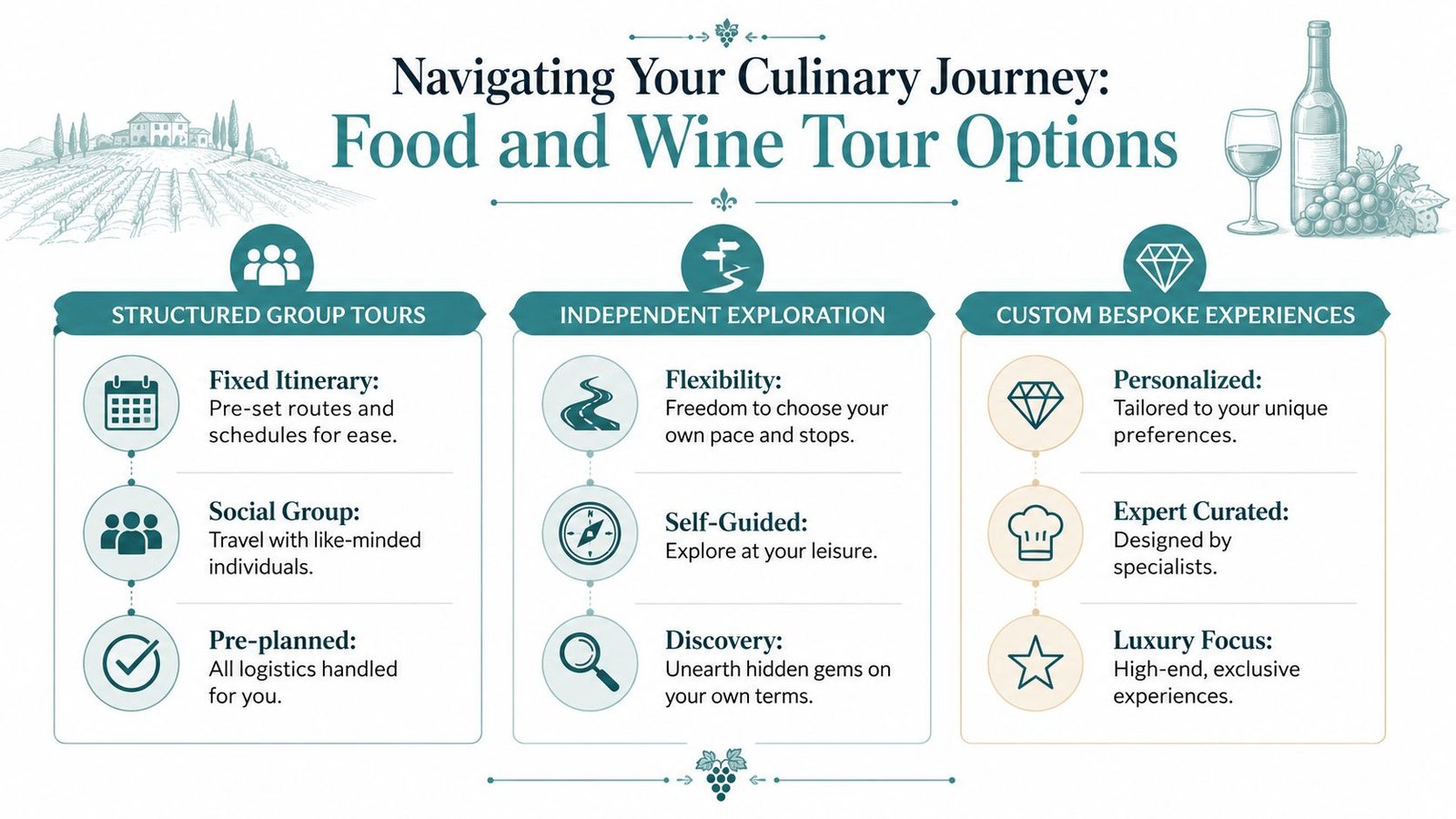
Wine-focused travel has grown into a major pillar of this world. Global wine tourism is projected to grow from USD $46.47 billion in 2023 to USD $106.74 billion by 2030, and tastings and tours are the dominant and fastest-growing service segment. That helps explain why so many travelers start with wine and then discover they're really seeking a fuller cultural journey.
Three ways to experience a destination
A large-group tour is like joining a well-rehearsed orchestra. The route is fixed, the tempo is set, and logistics are effortless. If you want predictability and don't mind compromise, it can work well.
A small-group tour feels more like a dinner party with strangers who may become friends. You still follow a shared structure, but there's often more room for questions, detours, and local interaction.
A private custom tour is different. It's less about fitting into an existing design and more about building one around you. If you care about hidden producers, unusual access, dietary nuance, or a slower rhythm, this format gives the experience room to breathe.
Later in the decision process, video can be helpful because tone matters as much as itinerary.
Choosing Your Tour Style Private vs Group Experiences
| Feature | Private & Custom Tours (La Sirena's Focus) | Small Group Tours | Large Group Tours |
|---|---|---|---|
| Pace | Set around your energy and interests | Shared pace with some flexibility | Fixed schedule |
| Access | Better chance of private homes, boutique venues, and specialist hosts | Some unique access | Usually public-facing stops |
| Conversation | Deep one-to-one time with guides and hosts | More personal than large tours | Often brief and general |
| Dietary needs | Easier to tailor in advance | Often manageable | More standardized |
| Group dynamic | Your own party only | Social, mixed travelers | Broad mix, less intimacy |
| Spontaneity | High, within the day's framework | Moderate | Low |
| Best for | Travelers who want immersion and curation | Travelers who want balance | Travelers who want convenience |
Practical rule: If your dream trip depends on timing, access, or personal interests, don't choose a format that treats those as afterthoughts.
The decision often comes down to one question. Do you want to join someone else's version of a place, or uncover your own?
How to Design a Tour with Heart and Soul
The most memorable itineraries don't begin with a map. They begin with a personality. Two travelers can arrive in the same wine region and want completely different things. One wants vineyard geology, barrel rooms, and vertical tastings. The other wants lunch in a village square, a cooking lesson, and enough time to wander without checking a watch.
That difference matters. A journey with heart and soul starts when you stop asking, “What should I see?” and start asking, “What kind of traveler am I when I feel most alive?”
Start with your traveler DNA
Before choosing wineries, restaurants, or regions, define your natural rhythm.
- If history pulls you in, build around old quarters, family estates, traditional markets, and meals with a story behind every course.
- If you're kitchen-curious, prioritize hands-on experiences. A bakery visit at dawn or a home cook's lesson often reveals more than another formal tasting.
- If wine is your language, decide whether you love technical depth, cellar intimacy, or pairings that connect bottles to local dishes.
- If you travel for atmosphere, leave space for slow afternoons, scenic drives, and meals that spill gently into evening.
A thoughtful planner listens for these signals. They hear “I love architecture” and suggest a historic bodega with a dramatic dining room. They hear “my partner doesn't drink much” and shape a day around food, scenery, and conversation instead of pouring after pouring.
Depth creates memory
The strongest argument against checklist tourism is simple. It often leaves you with quantity and very little emotional texture. You saw eight places, tasted twelve things, and remember almost none of the voices.
A different approach has a proven rhythm. High-end operators report approximately 75% repeat guest rates by prioritizing “fewer stops, deeper moments,” often limiting itineraries to five wineries over ten days. The point isn't austerity. It's attention. Guests remember family meals, hosted visits, and the extra hour that allowed a formal tasting to become a real conversation.
Linger where the experience opens up. Leave when it starts to feel like a schedule.
Concierge thinking is paramount. A well-designed culinary trip doesn't max out your day. It protects the moments that need air around them. The unrushed lunch. The winemaker who answers one more question. The village stop that wasn't on a checklist but becomes the story you tell first when you get home.
A tour with heart and soul isn't vague or sentimental. It's precise. It chooses depth on purpose.
Navigating the Practical Details of Your Trip
Dreaming is the easy part. Planning is where confidence gets built. The right practical choices shape whether your trip feels graceful or cramped, welcoming or stressful.
Choose timing by mood, not hype
Some travelers love the buzz of harvest season. Others want quieter roads, easier restaurant bookings, and more relaxed conversations with hosts. Neither choice is better. They create different moods.
Ask yourself what kind of energy you want. If you enjoy movement, celebration, and a stronger sense of seasonal labor, busy periods can be thrilling. If you value stillness and longer interactions, shoulder season often fits better.
Travel dates aren't just logistics. They shape the emotional tone of the whole journey.
This is also where regional planning matters. A city-based tasting route asks different things from you than a countryside itinerary with long lunches and scenic transfers. If you're pairing multiple stops into one trip, practical pacing becomes just as important as culinary ambition.
For a broader framework on sequencing flights, destinations, and timing, this guide on how to plan a vacation to Europe is a helpful starting point.
Know what to ask before you book
A polished brochure can hide plenty of important details. Ask clear questions early.
- What's included. Confirm whether tastings, meals, transfers, entrance fees, and gratuities are bundled or separate.
- How much walking is involved. Historic centers, vineyards, and cellar stairs can change the feel of a day.
- Who leads the experience. A driver, a general guide, and a specialist host all create different outcomes.
- How much free time remains. Some travelers want structure. Others need room to explore independently.
The best operators answer these without haze. If the response feels evasive, the trip may feel that way too.
Make room for everyone at the table
Food and wine tours should never exclude the person with dietary restrictions, the non-drinker, or the guest who wants culture more than alcohol. Good planning solves most of this in advance.
If someone avoids wine, a region can still be rich with olive oil tastings, market visits, heritage sweets, artisan cheese, architecture, countryside drives, or chef-led meals. If someone has allergies or follows a specific diet, detailed advance notice makes all the difference.
A few practical habits help:
- Share restrictions early, not after arrival.
- Describe preferences precisely. “No seafood” is different from “I'll try some seafood if it's local and central to the meal.”
- Ask about substitutions before the itinerary is finalized.
- Keep one flexible meal in the schedule for personal cravings or rest.
Polite winery etiquette also goes a long way. Arrive on time. Don't drown out the host with side conversations. If you're in a family home or boutique estate, treat the setting as someone's world, not content for a rushed photo stop.
When the logistics are thoughtful, you stop worrying about whether the trip will work for everyone. You get to enjoy it.
Curated Itineraries Inspiration for Your Journey
Some destinations make their culinary identity obvious from the first hour. Others unfold more gradually. The pleasure of a curated journey is that it reveals both kinds.
Valencia behind closed cellar doors
Valencia has that rare combination of sunlight, elegance, and understatement. Travelers often arrive expecting paella and seaside lunches. Those can be lovely, but the deeper pleasures usually sit a little farther from the obvious path.
In the surrounding wine country, private guiding can open doors that never appear on a public booking page. Some boutique wineries in Spain's Valencia region welcome private guided visits that are not open to the general public, and some estates limit access to fewer than 50 groups per year to preserve authenticity. That changes the tone immediately. You're not one more tasting slot. You're a guest.
A day like this might begin with a quiet drive through vineyards and stone villages. Then the gate opens. The host isn't reciting a script. They're talking about the land, a family decision, a harvest challenge, or why one parcel gets treated with special care. The tasting feels less like retail and more like invitation.
Argentina fire, Malbec, and midnight music
Argentina tells its story through intensity. Not loudness, but feeling. The crackle of an asado fire. The first cut of grilled meat. A deep pour of red wine at dusk. Music that pulls emotion straight to the surface.
Culinary travel becomes inseparable from atmosphere. A meal isn't just a meal. It belongs to the rhythm of the evening, to the people gathered around it, to the city or valley that shaped it. In the right itinerary, wine country doesn't sit apart from culture. It's braided into it.
For travelers drawn to this mix of vineyard settings and cultural depth, these wine tours in Argentina show how a curated route can connect tastings with the country's wider personality. One day might lead from a refined cellar to a rustic lunch under open sky. Another might end not with another formal course but with tango, candlelight, and the kind of late conversation that makes dinner feel unfinished in the best way.
Some destinations ask you to observe. Argentina asks you to participate.
The Baltics and the quiet surprise of the north
The Baltic States reward travelers who don't need a destination to announce itself. Estonia, Latvia, and Lithuania often surprise people because the experience isn't built on obvious culinary fame. It's built on subtlety, seasonality, and a strong sense of place.
This kind of journey suits curious eaters. You notice rye, forest ingredients, smoked flavors, preserved traditions, modern kitchens working with old recipes, and dining rooms where design and heritage meet without forcing the point. The pleasure comes from discovery.
A curated Baltic itinerary might move between elegant city restaurants, local markets, coastal settings, and countryside tables where the natural surroundings influence the menu with quiet authority. It feels intimate rather than theatrical. You don't leave thinking you conquered a food scene. You leave feeling you were let into one.
That's often the mark of the finest food and wine tours. They don't shout their sophistication. They reveal it slowly.
The La Sirena Vacations Concierge Approach
A boutique concierge model changes the experience before you ever step on a plane. Instead of choosing from a shelf of pre-built products, you work with a human point of contact who learns how you travel, what you care about, and where flexibility matters most.
That can mean private logistics, specialist guides, access to smaller producers, help balancing wine lovers with non-drinkers, or support when a corporate group needs polish without stiffness. It can also mean something less visible and just as important. Someone has already thought through timing, transitions, and host fit so the trip feels well-coordinated rather than overmanaged.
The strength of this approach is clarity. One team holds the thread from the first conversation through the final day on the ground. If plans need adjusting, you're not passed through layers of call centers or generic support queues.
For travelers who want to understand what that level of planning can include, these travel agency services show how high-touch trip design works in practice. The value isn't only luxury. It's coherence. Every part of the journey supports the same feeling of depth, access, and ease.
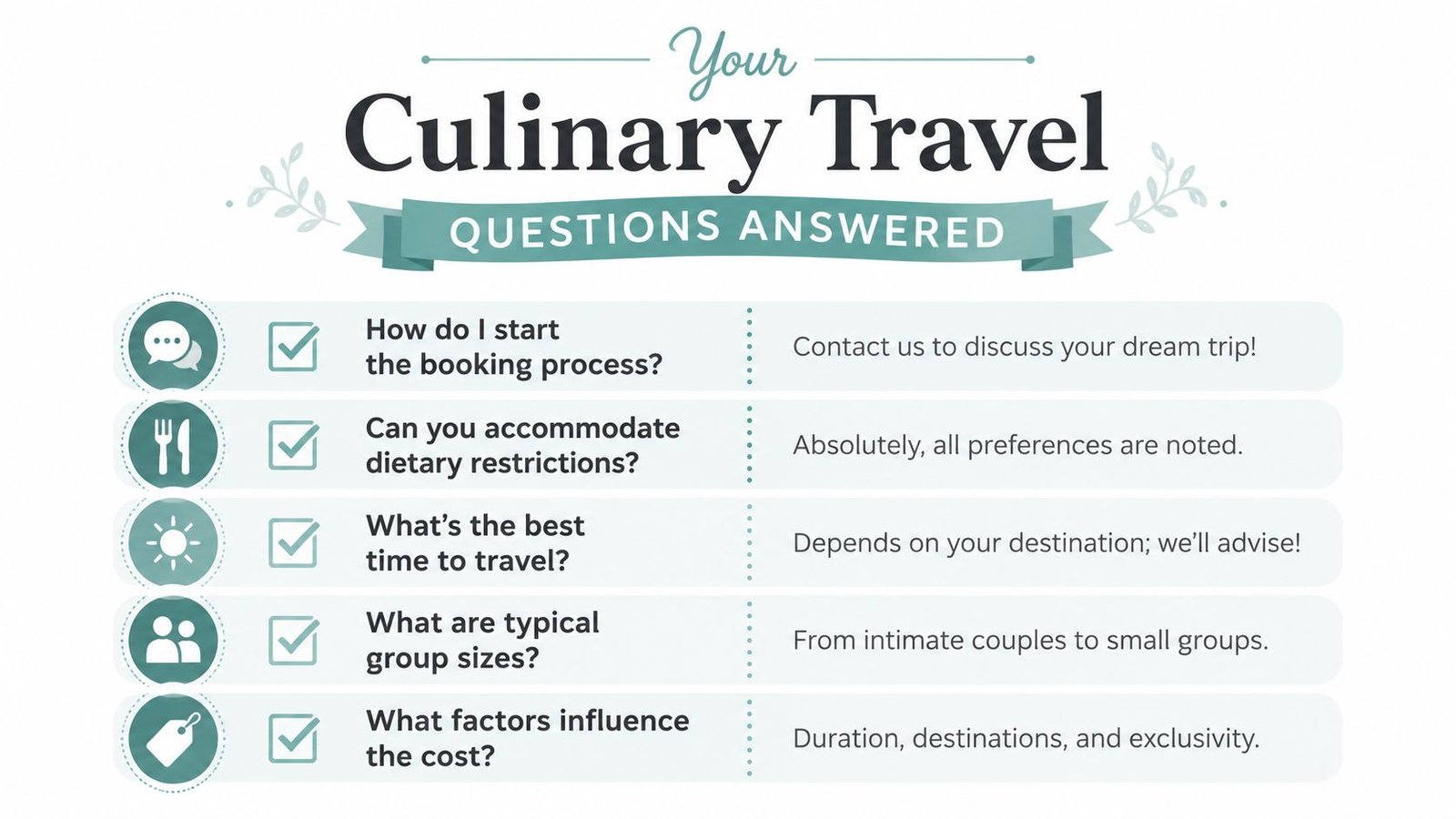
Your Culinary Travel Questions Answered
Even when the vision is clear, a few practical questions usually remain. Good. Those questions help you separate a beautiful idea from a trip that will feel right once you're there.
How do I know a tour is genuinely sustainable
Don't stop at the phrase “eco-friendly.” Ask what it means in the operator's daily decisions. One useful benchmark comes from traveler demand itself. A common question is how to verify a tour's sustainability claims, and 57% of travelers seek multi-day food and drink tours while prioritizing meaningful experiences. The practical test is to ask for specifics on local labor, waste reduction, and community support.
Ask direct questions such as:
- Who benefits locally. Are guides, drivers, and hosts based in the region.
- How waste is reduced. Do they minimize single-use items and manage food waste thoughtfully.
- What community support looks like. Are they directing business toward local producers and independent venues.
If the answers stay vague, keep looking.
What if someone in my group doesn't drink wine
They can still have a rich, satisfying trip. The best wine regions are rarely only about wine. They're about agriculture, scenery, architecture, kitchens, markets, and hospitality.
A non-drinker might enjoy the same estate visit for the scenery and conversation, then focus on local food, artisanal products, or cultural elements around the tasting. A strong itinerary gives every guest a meaningful role in the experience.
How does a custom booking usually work
It often begins with a conversation, not a checkout page. The planner asks where you want to go, how you like to travel, who's coming, what matters most, and what needs handling carefully.
From there, the trip takes shape through a series of choices rather than a generic package. Pace, accommodation style, transport, meal style, guide personality, and special access all get aligned. That's how the final journey feels personal instead of merely premium.
The best custom trips aren't complicated for the traveler. They're complicated behind the scenes, so the traveler can simply enjoy them.
Can dietary restrictions be accommodated
Usually yes, if they're shared early and clearly. Operators need time to coordinate with kitchens, hosts, and tasting venues. The more specific you are, the easier it is to create a smooth experience.
A thoughtful culinary trip should make people feel welcomed, not like an inconvenience.
If you're ready for a journey shaped by flavor, culture, and meaningful access, La Sirena Vacations creates private guided tours and custom travel experiences with the kind of care that turns a good itinerary into a story you'll keep telling.