
At dusk in Mendoza, I once watched a couple linger over the last pour of Malbec while the Andes turned violet behind the vines. Nobody rushed them. The winemaker stayed, the kitchen sent one more plate, and the whole evening felt less like a reservation and more like being welcomed into someone's world.
Table of Contents
- An Invitation to Experience Argentina's Soul
- The Four Hearts of Argentine Luxury
- Crafting Your Perfect Journey Sample Itineraries
- Exclusive Experiences Beyond the Guidebook
- Sanctuaries of Style Top Luxury Stays
- Navigating Argentina with Ease and Value
- Your Journey Begins with a Personal Touch
An Invitation to Experience Argentina's Soul
Luxury in Argentina rarely announces itself loudly. It arrives in smaller ways. A private guide notices you love architecture and changes the afternoon walk in Recoleta. A chef in Buenos Aires sends out a dish that isn't on the menu because you mentioned your grandmother cooked something similar. A gaucho in Patagonia says very little all morning, then points to a distant ridgeline with the kind of intimacy that only comes from a life lived outdoors.
That's why luxury trips to Argentina stay with people. The country gives you grandeur, of course. There are the broad avenues of Buenos Aires, the ordered rows of Mendoza vines, the wind-cut immensity of Patagonia, and the humid thunder of Iguazú. But what lingers later is usually something more personal. It's the feeling that the trip met you where you are.
Argentina's appeal at the high end isn't a niche story anymore. The Argentina luxury travel market outlook from Grand View Research projects that the market will reach nearly USD 48 billion by 2033, a sign of how strongly travelers are seeking authentic, personalized experiences in places such as Mendoza, Patagonia, and Buenos Aires. That feels right to anyone who has spent time here with care.
Luxury here means access, not excess
The best journeys in Argentina don't revolve around collecting flashy moments. They revolve around access.
Sometimes that means a sommelier who opens the smaller-production bottle that never appears on the export list. Sometimes it means stepping into a tango salon before the evening crowd arrives, when the wooden floor is still quiet and the mirrors hold the last amber light of the day. Sometimes it means being driven out of the city just far enough to hear birds instead of traffic.
Practical rule: In Argentina, the most memorable luxury is usually the thing that feels least staged.
Travelers often arrive expecting a classic high-end formula. They leave talking about texture and atmosphere. The old elevator cage in a Belle Époque building. The cold air rushing in as a lodge door opens in Patagonia. The scent of eucalyptus after a summer storm in wine country.
What makes the experience feel personal
A good itinerary in Argentina should feel edited, not packed. That's especially true for travelers coming from Europe, including Spain, who want the trip to balance comfort with emotional depth.
A more personal approach usually includes:
- Private guiding with local sensitivity: Not someone reciting facts, but someone who knows when to slow down, skip the obvious, or stay longer.
- Experiences that match your temperament: Some travelers want private tango and gallery appointments. Others want horseback rides, fireside dinners, and long lunches among vines.
- Space for spontaneity: Argentina rewards itineraries that leave room for appetite, weather, and mood.
That's the difference between a luxury trip that looks beautiful on paper and one that feels like it was made for you.
The Four Hearts of Argentine Luxury
Argentina doesn't offer one style of luxury. It offers several, each with its own emotional register. Some travelers want city elegance. Some want mountain air. Some want the sensory rhythm of vineyards. Others want the kind of natural force that makes conversation stop mid-sentence.
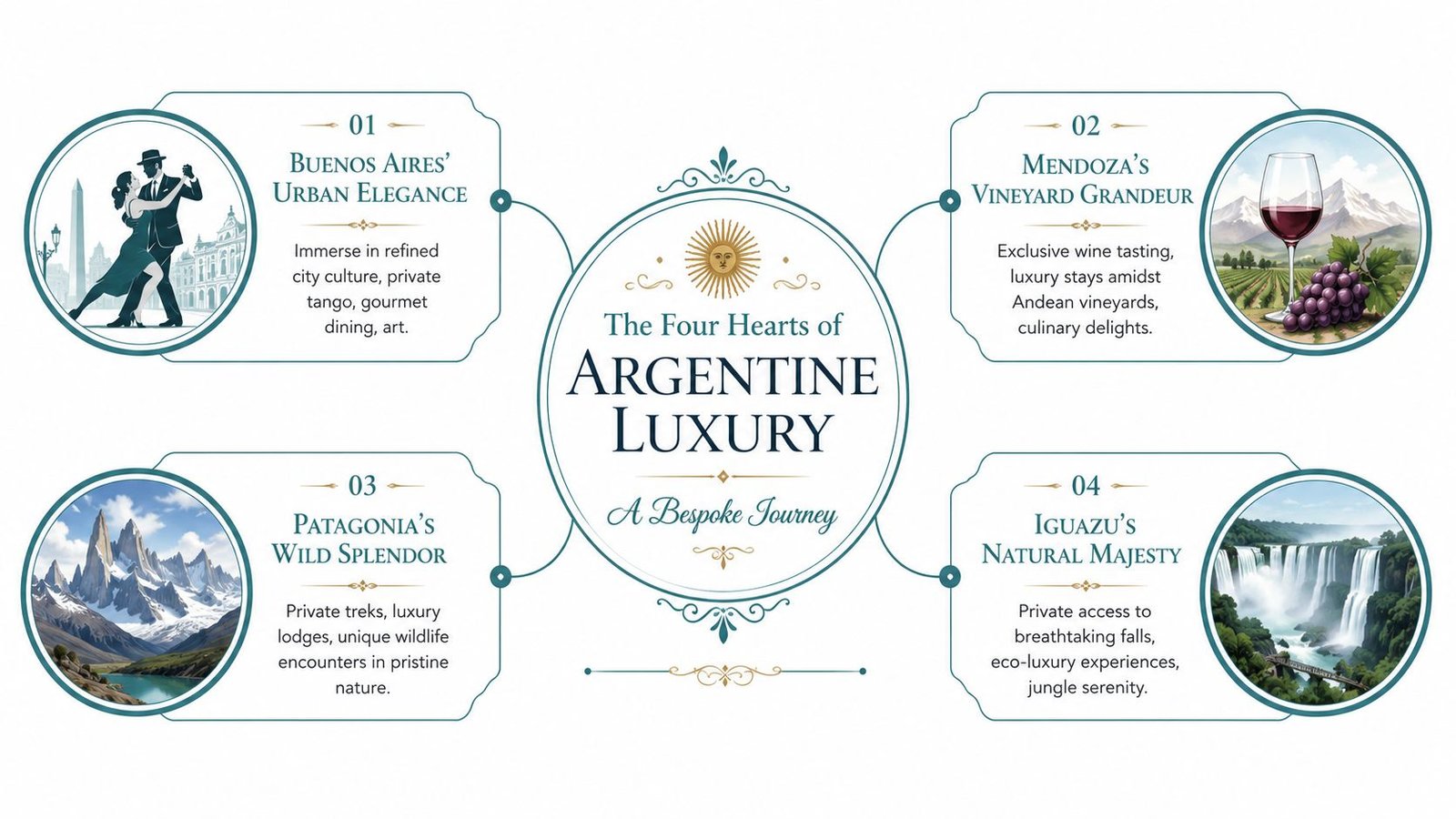
If you're beginning to sketch your route, this guide to places to visit in Argentina is a useful starting point. But the real decision isn't just where to go. It's which version of Argentina speaks most clearly to you.
Buenos Aires and its elegant pulse
Buenos Aires seduces slowly. It isn't polished in a sterile way. Its beauty comes with creases, faded grandeur, stubborn style, and neighborhoods that still feel lived in.
One morning might begin with coffee and medialunas beneath stained glass in an old café. By afternoon, you're in Recoleta, stepping through avenues lined with aristocratic apartment houses and tiny details that reward people who look up. At night, the city changes register. Tables fill late. Conversation lengthens. A private tango lesson doesn't feel like a performance here. It feels like learning a local language with your body.
For travelers who love cities, Buenos Aires offers a kind of urban luxury that's tied to culture.
- For art lovers: Private gallery visits, museum pacing without crowds, and architecture-led walks can reveal the city's layered identity.
- For food lovers: Closed-door dinners and thoughtful parrilla experiences often say more about Argentina than any formal tasting menu.
- For romantics: Nothing beats a late dinner, a short walk through a leafy barrio, and that peculiar Buenos Aires glow after midnight.
Mendoza and the art of slowing down
Mendoza feels sunlit even in memory. The roads are lined with poplars. Irrigation channels murmur beside sidewalks. The Andes hover in the distance like scenery designed by someone with a dramatic streak.
Luxury softens into ease. You wake to vineyard light. Breakfast stretches. A tasting begins with one wine and somehow turns into a conversation about altitude, harvests, and family recipes. Lunch becomes the center of the day rather than a stop between activities.
The finest Mendoza experiences often work because they don't try too hard. They trust the natural surroundings.
The most convincing luxury in Mendoza is time used well. A long table, a mountain view, and no pressure to move on.
Travelers who come here often think wine will be the whole story. Then they remember the olive oil, the fire cooking, the silence between rows of vines, and the way the Andes make even ordinary moments feel composed.
Patagonia and the luxury of silence
Patagonia strips things back. The roads get emptier. The sky gets larger. Hotel design matters here, but not because of showmanship. It matters because a lodge should frame the vista, not compete with it.
Luxury in Patagonia is often about contrast. You head out into raw weather, glacial blue water, steppe, forest, or granite peaks. Then you return to a fire, a deep bath, a good glass of wine, and windows that make the outside feel close even when you're warm inside.
This region suits travelers who want movement in the day and stillness at night. It also suits people who think privacy is the highest amenity.
A few Patagonian pleasures tend to define the experience:
- Private guiding: The right guide changes everything, especially in a place where weather and terrain shape each day.
- Remote lodges: Distance becomes part of the gift. Fewer distractions. More immersion.
- Nature with comfort: You can spend the day among glaciers, lakes, or windswept plains and still return to refined service.
Iguazú and the force of the natural world
Iguazú offers a different kind of luxury altogether. It isn't subtle. The falls announce themselves with mist, sound, motion, and jungle heat.
Yet there's refinement here too, if you approach it well. A private outing at the right hour can shift the experience completely. You hear birds before the walkways fill. You notice butterflies and wet leaves, not just the headline spectacle. The jungle becomes more than a backdrop.
Iguazú works beautifully as a counterpoint to the rest of the country. After city sophistication, wine country ease, or Patagonian austerity, it reminds you that Argentina also holds tropical intensity. It brings drama to an itinerary that might otherwise stay in one emotional key.
For many travelers, these four regions become less like stops and more like moods. Buenos Aires invites. Mendoza loosens. Patagonia humbles. Iguazú overwhelms in the best way.
Crafting Your Perfect Journey Sample Itineraries
The best itineraries don't read like checklists. They read like stories with good pacing. In Argentina, that matters more than people expect because distances are real, the terrain varies greatly, and each region asks for a different kind of attention.
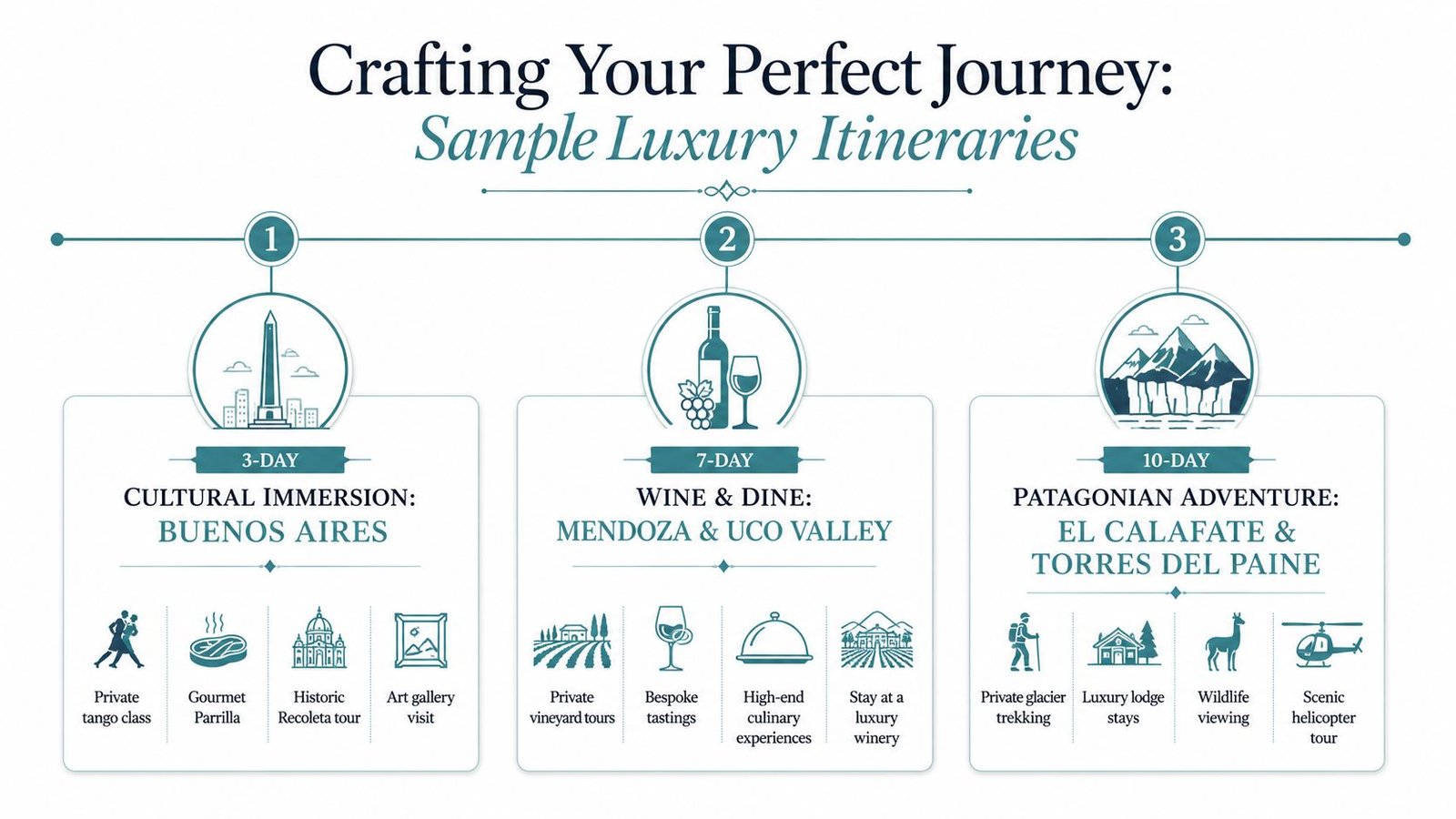
A short trip can be wonderful if it stays focused. A longer trip becomes magical when it respects rhythm. The main mistake I see is trying to make Argentina feel smaller than it is. It isn't. And forcing too much into too little time can flatten even the most beautiful route.
For the traveler who wants a deep city exhale
A 3-day cultural immersion in Buenos Aires works best when it goes inward rather than wide. Don't race across the whole city. Pick a few neighborhoods and let them open.
Day one might center on arrival and atmosphere. Stay somewhere with character, rest properly, then head out for a gentle walk through Recoleta or Palermo. Keep dinner elegant but not overplanned. The point is to adjust to the city's cadence, not conquer it.
Day two is where private access matters. A personalized architecture walk, an art-focused afternoon, or a tango lesson in a historic setting turns a quick stay into a shaped experience. By day three, many travelers are ready for something domestic and intimate. A market visit, a long lunch, or a conversation-driven food experience often leaves a stronger impression than one more landmark.
This kind of trip suits:
- First-time visitors with limited time
- Corporate travelers adding a cultural extension
- Couples who want urban romance without airport-hopping
For the traveler drawn to wine and wide skies
A 7-day Buenos Aires and Mendoza escape gives you contrast without strain. The city supplies texture and energy. Mendoza offers release.
Start with a few nights in Buenos Aires so the trip begins with culture, movement, and appetite. Once you've had your fill of galleries, cafés, and late-night dinners, fly west. Mendoza should feel slower from the first hour. Don't overbook tastings. Two meaningful winery visits in a day, with proper meals and time to sit, are often richer than trying to fit in too many labels.
A strong version of this itinerary usually includes:
- A city opening: Buenos Aires is the right place to begin because it grounds the trip in Argentine identity.
- A vineyard middle: Mendoza then shifts the body into a different tempo.
- A soft landing: The final days should leave space for spa time, mountain views, or one last unhurried lunch.
Good luxury planning in Argentina often means removing one activity, not adding one.
For the traveler dreaming of the full Argentine arc
The most satisfying version of a broader journey combines Buenos Aires, Mendoza, and Patagonia. But this only works if you give it enough time. A luxury Argentina planning guide from Kuoda Travel notes that a complete itinerary needs at least 10 to 14 days, largely because Patagonia's prime travel window is November through March, and that seasonality shapes the entire route.
That timing matters. Patagonia isn't the region you casually squeeze in. It dictates availability, weather expectations, and the logic of the whole trip. If you're trying to weave in wilderness at the highest level, the trip should be built around it from the start.
A 14-day framework might look like this:
| Journey Arc | Focus | Feeling |
|---|---|---|
| Days in Buenos Aires | Culture, design, tango, gastronomy | Immersive and social |
| Days in Mendoza | Vineyards, long lunches, mountain views | Sensory and restorative |
| Days in Patagonia | Nature, remote lodges, guided outings | Expansive and elemental |
The sequence works because each destination resets the senses. Buenos Aires sharpens them. Mendoza softens them. Patagonia clears them.
For travelers who want one unforgettable trip rather than several smaller ones, this is often the itinerary that delivers the full emotional range of Argentina. It's also the version that benefits most from patient planning, especially when lodge space in Patagonia becomes scarce during the southern summer.
Exclusive Experiences Beyond the Guidebook
The difference between a beautiful trip and a transformative one usually comes down to access. Not status access. Human access. The kind that lets you step behind the polished surface of a destination and feel something living underneath it.
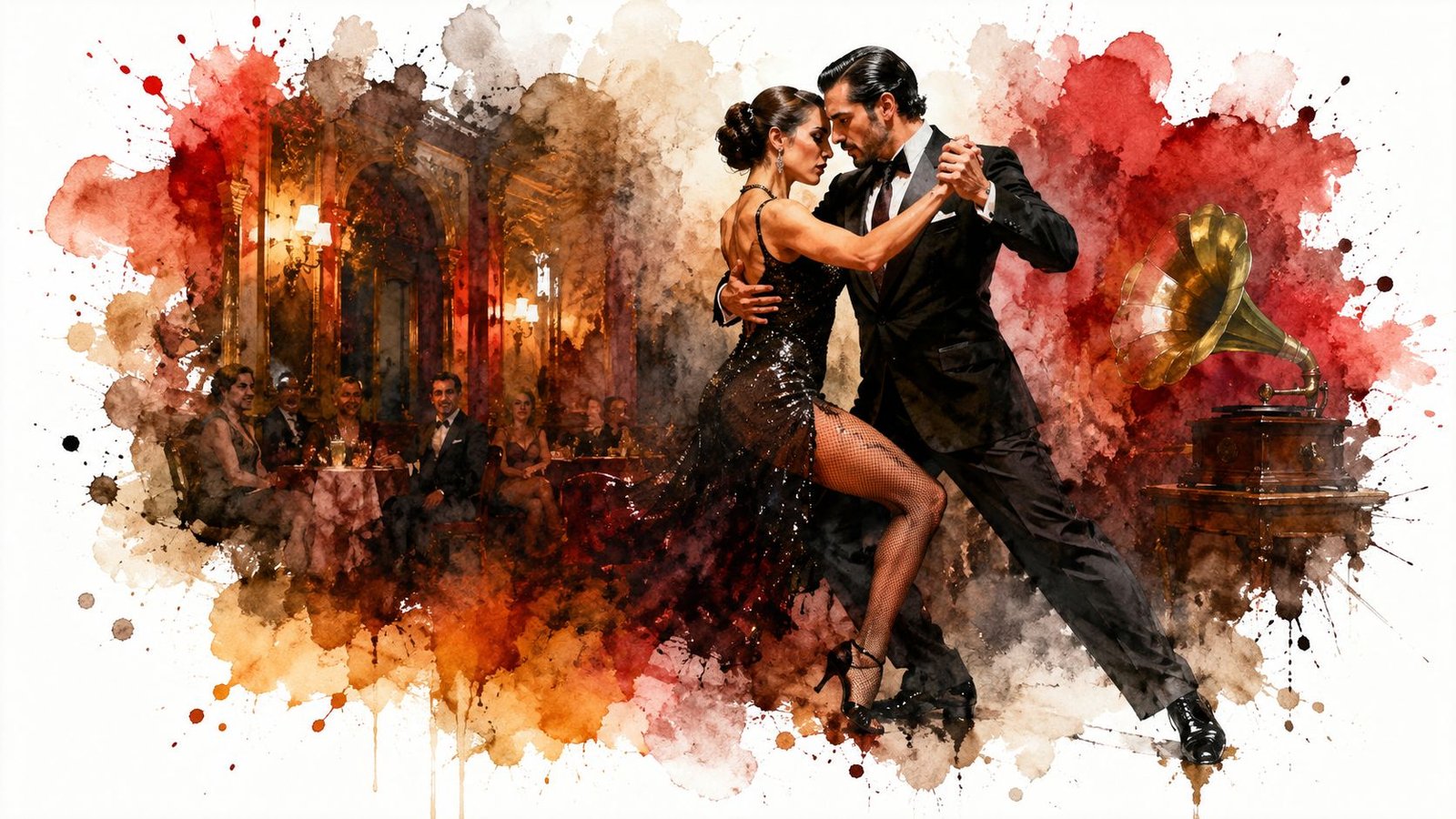
In Argentina, that often means moving past the public version of an experience and into a more intimate one. A tango show can be dazzling, but a private lesson in an old salon has a different kind of electricity. You hear the count, notice the floorboards, laugh at your own hesitation, and understand that tango is less about spectacle than trust.
The moments people remember most
The experiences people talk about years later tend to share one thing. They feel impossible to mass-produce.
In Buenos Aires, that might be a closed-door dinner hidden behind an ordinary façade, where the chef cooks according to the season and the table conversation becomes part of the evening. In San Telmo, it could be a private tango session with dancers who treat the lesson as a conversation about posture, history, and mood, not just steps.
In Mendoza, a polished tasting room is lovely, but the more memorable moment is often smaller. A blending session with a winemaker. A barrel sample pulled just for your table. A lunch among vines that stretches into the afternoon because nobody is trying to turn the table.
For travelers focused on wine, these curated wine tours in Argentina show how much richer the region becomes when visits are designed around taste, pace, and personality rather than volume.
A few experiences that consistently redefine luxury here:
- Private tango in a historic setting: Better than a standard show if you want emotional connection.
- By-invitation dining: These evenings often reveal the city's culinary soul more clearly than the obvious restaurant circuit.
- Hands-on wine encounters: Blending, cellar access, and food pairings deepen the memory of Mendoza.
- Nature by private boat or guide: In Patagonia, privacy changes scale. The scenery feels larger when the day is quieter.
Why privacy changes the experience
Privacy isn't just about exclusivity. It changes how you notice things.
When you visit a glacier by private boat or arrive at a vineyard before the day fully begins, there's room for silence. You hear the crack of ice, the movement of water, the wind through leaves, your own reaction. Shared space can be joyful. But solitude, or near-solitude, often turns beauty into intimacy.
This short film captures some of that emotional pull.
Luxury isn't seeing more. It's being allowed to feel more.
That's why the best luxury trips to Argentina don't merely collect premium reservations. They shape encounters. They make room for the unexpected conversation, the extra glass poured off-menu, the guide who senses that today should be slower, or the scenery that doesn't need to be explained at all.
Sanctuaries of Style Top Luxury Stays
Where you stay in Argentina should deepen your sense of place. The best properties don't feel interchangeable with luxury hotels anywhere else. They feel rooted. They understand that a mansion in Buenos Aires, a vineyard retreat in Mendoza, and a lodge in Patagonia should each express luxury differently.
City hotels with character
In Buenos Aires, the most compelling stays tend to be those with architectural memory. Recoleta suits travelers who love old-world polish, high ceilings, hushed service, and the feeling of being in a city that has lived many lives. A restored mansion or a grand hotel with historical detail often says more about Buenos Aires than a sleek international tower ever could.
Palermo offers another style. It's more contemporary, more design-forward, and often better for travelers who want boutique scale and immediate access to restaurants, galleries, and leafy streets. Here, luxury can feel less formal and more creative.
What matters in the city isn't only thread count or spa menus. It's whether the property helps you inhabit the neighborhood.
Wine country retreats
Mendoza's standout hotels understand that scenery is part of the service. The best vineyard stays frame the Andes, respect the natural surroundings, and avoid overcomplicating the experience. You want a room that opens to vines, a terrace that catches the late light, and a dining room that treats local produce and wine with intelligence.
A strong wine lodge also manages tempo well. It should make it easy to do very little without feeling idle. That might mean a long breakfast, a slow tasting, an afternoon treatment, and dinner after sunset with the mountains still visible. Mendoza luxury works when it feels unforced.
Choose the property that fits the trip's mood. In Mendoza, serenity often matters more than scale.
Patagonian lodges that belong to the landscape
Patagonia asks more of a hotel. The property must provide comfort, yes, but also shelter, orientation, and a sense of belonging in a place that can feel immense.
The finest lodges succeed because they understand proportion. Large windows are there to honor the view, not to show off. Natural materials soften the severity outside. Staff know that returning guests from a cold excursion may want soup before anything else. Service becomes intuitive because conditions shape need.
When evaluating Patagonian stays, I look for three things:
| Quality | Why it matters | What it feels like |
|---|---|---|
| Sense of place | The lodge should reflect the region rather than override it | You remember the setting as much as the room |
| Guiding and logistics | Remote landscapes require capable coordination | Days feel smooth, not stressful |
| Warmth of service | In wild settings, hospitality becomes emotional | You feel cared for, not just accommodated |
That's the Argentine difference at its best. Luxury isn't generic comfort. It's a stay that could only exist exactly where it is.
Navigating Argentina with Ease and Value
Argentina rewards travelers who plan with nuance. It can feel generous, surprising, and full of value, but only if you understand the local rhythm. That means timing your regions well, staying realistic about distances, and paying attention to the economic context that many standard travel guides barely mention.
When to go and why timing matters
The country doesn't have one ideal season for everything. A polished city stay in Buenos Aires and a wine-led trip in Mendoza can work across a broad calendar, while Patagonia is more restrictive if you want the full high-end experience.
Here's a simple planning table for the main luxury regions:
| Region | Best Months | Experience Highlights |
|---|---|---|
| Buenos Aires | Broad seasonal flexibility | Architecture, private tango, art, dining |
| Mendoza | Broad seasonal flexibility | Vineyards, culinary experiences, mountain views |
| Patagonia | November to March | Remote lodges, guided nature, prime access |
| Iguazú | Broad seasonal flexibility | Falls, jungle immersion, eco-luxury stays |
If Patagonia is part of the dream, build around it first. Then let the rest of the itinerary support that decision rather than compete with it.
The currency question travelers often miss
Argentina offers both exciting and complicated scenarios. The country can offer striking value at the luxury end, but that value isn't static. A trip that looks simple on paper may behave differently on the ground if pricing shifts, exchange conditions change, or suppliers structure costs in different currencies.
A planning note on Argentina from Black Tomato makes this point clearly: Argentina's volatile currency means a trip's real cost can fluctuate significantly, and working with a local expert is essential to avoid hidden budget risks and maximize value. That insight matters far more than most travelers realize.
This affects practical decisions such as:
- How accommodations are priced: Some high-end lodges price more predictably than local services do.
- How spending money is handled: Day-to-day costs can feel different from pre-trip estimates.
- How flexible your budget needs to be: Fixed expectations can create friction in a country that changes quickly.
The cheapest-looking plan isn't always the best-value plan. In Argentina, clarity often saves more stress than bargain hunting.
Transfers visas and practical rhythm
Domestic movement deserves respect here. Internal flights are often the right choice when combining distant regions, especially if you want to keep the trip comfortable. Long overland transfers can be scenic, but they should be chosen because you want the road, not because the itinerary underestimated geography.
For a smoother journey, keep these principles in mind:
- Cluster experiences thoughtfully: Don't zigzag across the map just to fit in one extra stop.
- Protect arrival days: After a long-haul flight, begin gently.
- Use private transfers where they matter most: Airport transitions and remote lodge connections are usually worth simplifying.
- Check entry requirements early: Visa rules depend on your nationality, and travelers should always confirm current requirements before departure.
Luxury in Argentina isn't only about where you sleep or what you taste. Sometimes it's the absence of friction. The right sequence, the right season, and the right financial guidance can make the whole journey feel calm and beautifully coherent.
Your Journey Begins with a Personal Touch
The finest luxury trips to Argentina don't feel assembled from a template. They feel remembered before they happen. A city evening that turns into your favorite meal of the year. A vineyard afternoon that lingers longer than planned. A Patagonian morning so quiet it changes your breathing.
There's also a practical grace to Argentina when the trip is shaped well. As outlined in this look at Argentina's luxury travel value, a two-week luxury journey can cost $10,000 to $18,000 and offer value that is 30-40% greater than comparable trips in Europe. That combination of depth, beauty, and relative value is part of the country's magnetism.
But value alone isn't the reason to come. Meaning is.
If you're wondering whether expert planning makes a difference, this perspective on why to use a travel agent is worth considering. In a destination as layered as Argentina, peace of mind is often the ultimate luxury. Knowing the route makes sense. Knowing the timing is right. Knowing the details have been handled by someone who cares how the journey feels, not just how it looks.
If you're ready to shape a journey with more heart, La Sirena Vacations creates private, customized travel experiences designed around culture, wine, nature, and the kind of meaningful moments that make Argentina unforgettable.