
You're probably in the thick of it right now. A leadership retreat, client summit, incentive trip, annual meeting, or multi-day conference has landed on your desk, and the expectation isn't just that it runs on time. It has to feel polished, purposeful, and memorable. The executives want business results. The attendees want something worth leaving their routines for. And you're standing in the middle, turning a mandate into an experience people will remember.
That's where corporate event planning gets interesting.
The work has never been only about room blocks, name badges, and run-of-show documents. Good planners handle those basics. Great planners shape atmosphere, energy, and meaning. They understand when a board dinner should feel intimate rather than grand, when a workshop needs movement instead of another slide deck, and when a destination itself can do half the storytelling. In boutique travel and concierge work, that difference matters. A generic event gets polite applause. A curated one changes how people connect to the company, to each other, and to the place hosting them.
The scale of the industry reflects how seriously organizations take these gatherings. The global corporate events market is valued at USD 369.65 billion in 2026 and is projected to reach USD 686.49 billion by 2031, with a 13.18% CAGR, according to Mordor Intelligence's corporate events market analysis. That growth says something simple and important. Companies still see in-person events as strategic investments.
Table of Contents
- From Mandate to Masterpiece An Introduction
- Laying the Strategic Foundation for Success
- Crafting the Attendee Journey with Heart and Soul
- Finding the Perfect Stage for Your Event
- Assembling Your On-the-Ground Dream Team
- Measuring What Truly Matters Beyond the Bottom Line
- Your Event Planning Timeline and Checklist
From Mandate to Masterpiece An Introduction
At 9:07 on a Monday morning, the brief lands in your inbox. Leadership wants a retreat that sharpens strategy, rewards top performers, and brings people closer as a team. The request sounds tidy. The actual work rarely is.
A strong corporate event has to satisfy the spreadsheet and the human beings in the room. It has to run on time, stay on budget, and support a business goal. It also has to create the kind of moments that change how people connect once they leave. That second part is where many otherwise well-run events fall flat.
I have found that the difference usually comes down to intent. Plenty of teams can book flights, manage rooming lists, and build an agenda. Fewer know how to shape an atmosphere. Fewer still know how to root an event in a destination so it feels specific instead of interchangeable.
That is where boutique planning earns its keep.
A private paella gathering in Valencia can open people up faster than another branded welcome drink in a generic hotel lounge. In Argentina, a thoughtfully hosted evening around food, wine, and local craft can turn a reward trip into a shared story. In the Baltics, the right historic venue and neighborhood-led experience can give an executive meeting depth, restraint, and character without forcing the point. These choices are not decoration. They influence energy, conversation, and memory.
A polished agenda keeps the day on track. A well-built sense of place gives the event staying power.
The planners who create standout corporate events act like producers and hosts, not only coordinators. They know when to keep things formal and when to loosen the structure. They know that a ballroom is sometimes the right answer, and sometimes the smarter choice is a courtyard, a vineyard, a design hotel, or a private residence with a strong local story. They also know the trade-off. Experiences with personality take more judgment, better local partners, and tighter operational control.
That extra care is often what people remember.
If the goal is an event with heart and soul, logistics still matter. They just are not the whole job. The opportunity is to combine precision with cultural texture, so the event supports the business objective and feels grounded in the place where it happens. Teams that want that balance often work with specialists in corporate travel and event concierge services because local access and judgment shape the outcome as much as the run-of-show.
Laying the Strategic Foundation for Success
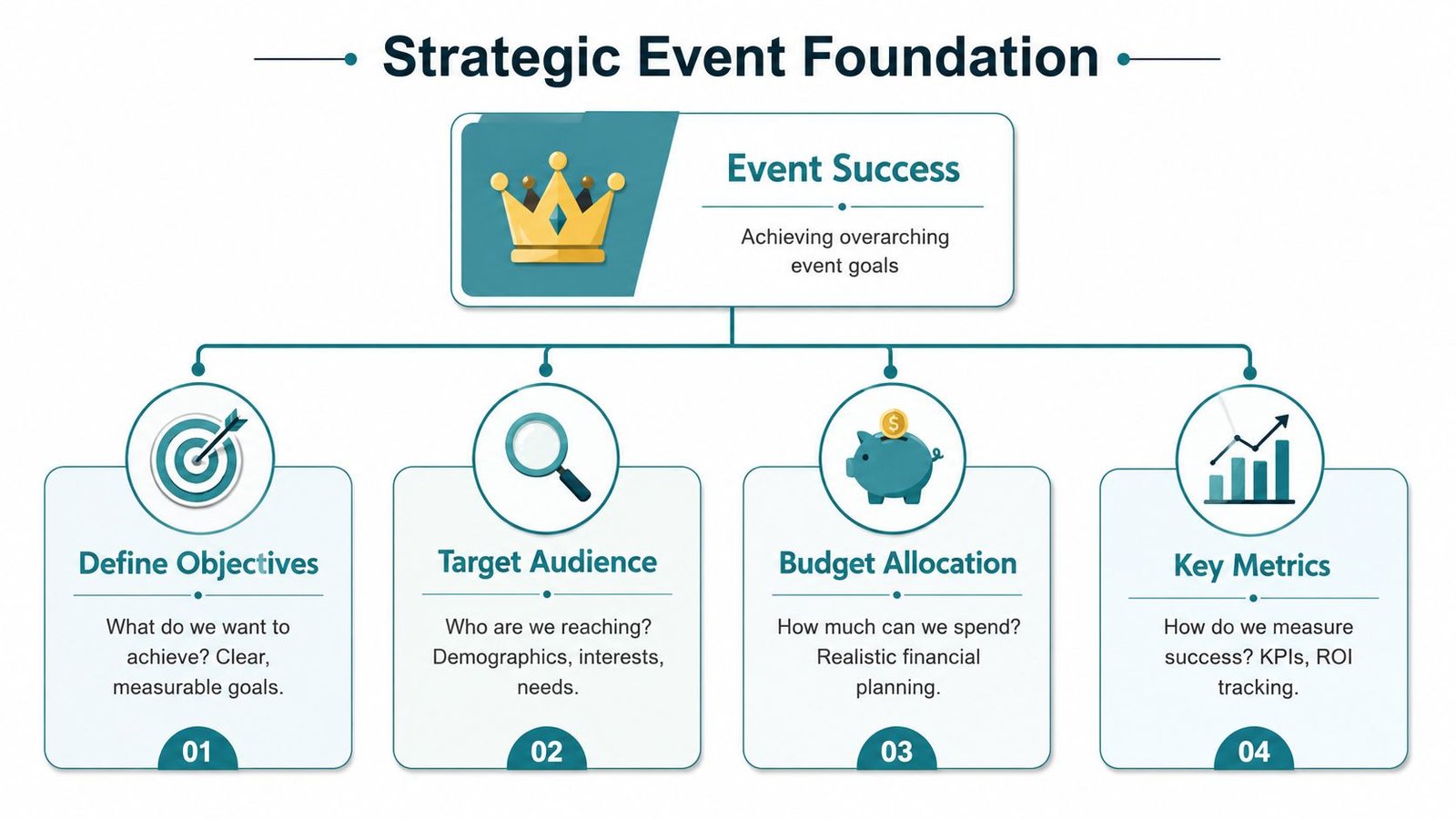
The fastest way to derail corporate event planning is to start with ideas before you've defined the reason for gathering. Vineyard dinner, keynote shortlist, printed gifting, catamaran charter. All of that can come later. First, decide what success means.
Start with the business reason
A strong brief answers five questions. Why are you doing this now? Who needs to be in the room? What needs to change after the event? What will attendees remember? What would make leadership call the event worthwhile?
The SMART framework is useful because it forces precision. Its importance is often greater than anticipated. A planning guide from Naboo notes that 40% of underperforming events lacked clear, measurable objectives at the planning stage, and it recommends defining the mandate before venue booking while also keeping a contingency fund of 10% to 15% of the total budget in reserve, as outlined in Naboo's corporate event planning success guide.
If your objective is “bring the team together,” that's too vague to guide decisions. If your objective is “align regional leaders around next year's priorities and create enough informal time for peer problem-solving,” you can plan against it. The session design changes. The venue changes. Even the dinner format changes.
A practical planning brief should include:
- Primary outcome: Name the one thing that must happen if the event is to be considered a success.
- Audience reality: Write down who's attending, what they care about, and what might frustrate them.
- Decision filters: Set criteria for venue, content, and activities before anyone falls in love with the wrong idea.
- Non-negotiables: Accessibility, executive privacy, brand standards, transfer timing, or cultural considerations.
For teams that need outside support with logistics and trip architecture, custom travel agency services for group and corporate planning can help turn a strategic brief into a practical operating plan.
Build the budget for reality, not optimism
Budgets fail when teams treat them like wish lists. They hold up when planners assign money according to event priorities and protect the plan from surprises.
The contingency line is not optional. If weather shifts, a supplier runs late, a room reset takes longer than expected, or a transfer plan needs to change on the ground, that reserve keeps the event stable instead of forcing reactive cuts. Calm planning always looks more elegant than dramatic problem-solving.
Practical rule: Build the budget in layers. Core experience first, operational necessities second, enhancements third.
A useful way to frame spending decisions is with a short comparison:
| Budget choice | What works | What doesn't |
|---|---|---|
| Venue spend | Paying for a setting that supports your event goals | Overspending on prestige while ignoring flow |
| Experience spend | Funding one or two meaningful signature moments | Adding scattered extras with no narrative purpose |
| Logistics spend | Protecting transport, staffing, and technical support | Assuming things will “probably be fine” |
| Reserve fund | Holding back the contingency amount from day one | Raiding that reserve before contracts are complete |
Get support before you get creative
Stakeholder alignment is often the quiet make-or-break factor. The C-suite may want strategic visibility. Sales may want client access. HR may care about inclusion, pacing, and attendee comfort. Marketing may want brand consistency and post-event content. If you don't surface those expectations early, they collide late.
Good planners don't ask everyone to approve everything. They identify who owns which decisions, where input is needed, and what trade-offs are acceptable. That keeps the process moving.
When this foundation is solid, the creative work becomes easier. You're no longer choosing between random nice ideas. You're selecting experiences that serve a defined purpose.
Crafting the Attendee Journey with Heart and Soul
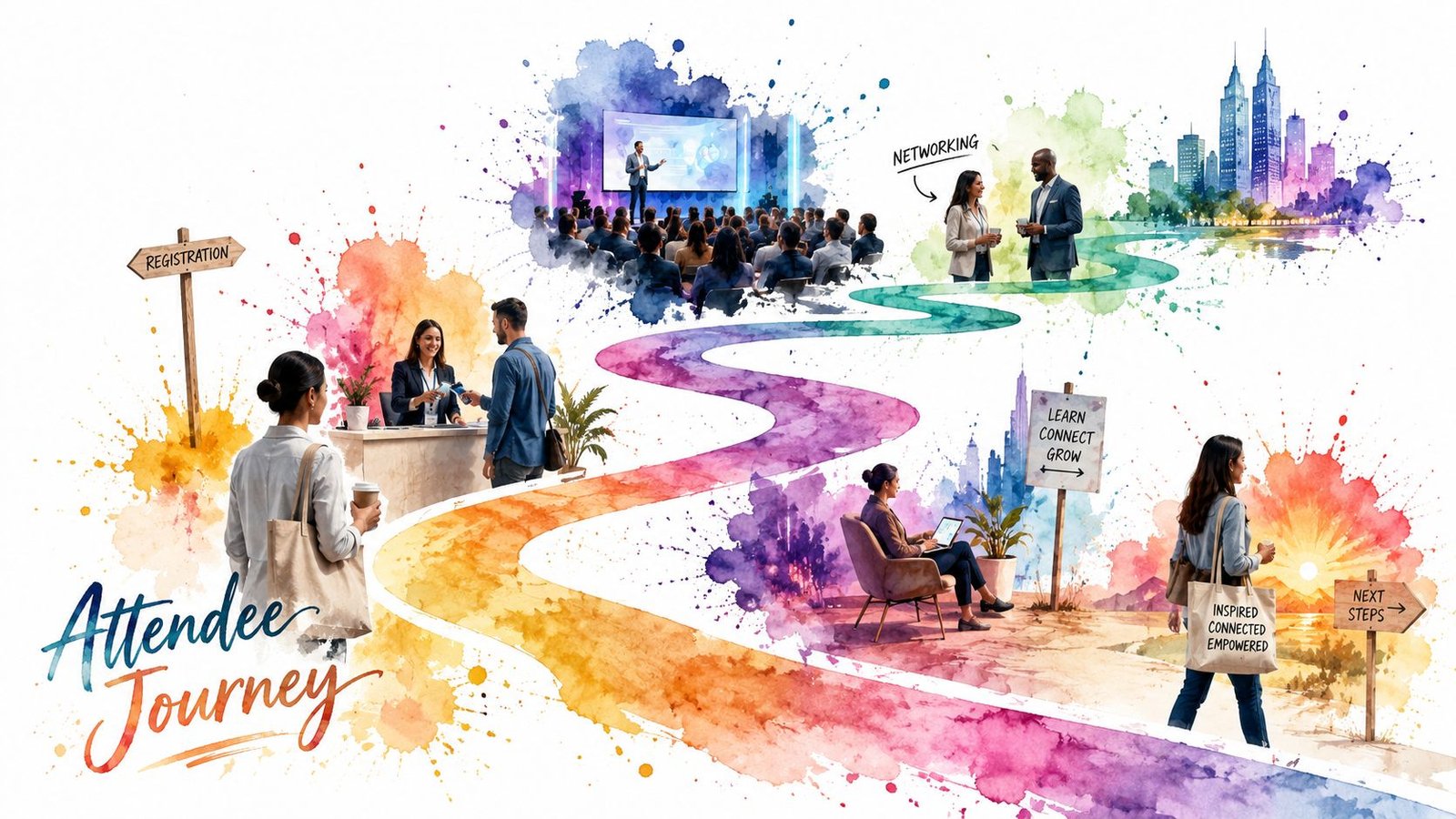
The biggest shift in corporate event planning is this. Stop thinking in terms of agenda blocks and start thinking in terms of the attendee journey.
An attendee doesn't experience your event as a spreadsheet. They experience it as a sequence of feelings and signals. Was registration smooth or stressful? Did the first hour feel welcoming or transactional? Did the content energize them or drain them? Did the destination offer any real sense of place, or could the event have happened in any hotel ballroom in the world?
Design the full emotional arc
A strong event has rhythm. It opens with clarity, builds momentum, creates room for exchange, and lands with purpose. That rhythm should shape every touchpoint.
Consider the contrast:
- Scheduling mindset: Book sessions, assign meal times, slot in an activity.
- Journey mindset: Build anticipation before arrival, create a warm first impression, balance focus with release, and leave attendees with a clear emotional and professional takeaway.
That difference changes details that many teams overlook. Pre-arrival messaging should answer practical questions cleanly and set the tone. Arrival should feel guided, not chaotic. Content-heavy mornings need breathing room afterward. Networking works better when it's anchored by context, not forced through awkward mixers. Cultural moments need thoughtful framing so they feel respectful and immersive rather than decorative.
A business dinner in a character-filled local setting can do more for conversation than a generic banquet room. A guided artisan visit, private music session, or food experience led by someone rooted in the destination can help attendees remember not just what they discussed, but where they were and why it mattered.
Don't ask whether an activity is memorable. Ask whether it belongs in the story of this event.
Make social impact participatory
Many teams want to include a social impact element. The instinct is good. The execution is often thin.
The stronger approach is community-led and collaborative. That matches a growing planning trend. As noted in Cultivate's 2025 event planning trends article, planners are increasingly blending business events with social impact, but the meaningful versions are immersive, community-led experiences co-designed with local stakeholders rather than generic gestures.
That means the activity should serve local priorities, not just corporate optics. If a team spends time with a local initiative, the hosts should shape the format. If sustainability is part of the event story, attendees should understand the context and the reason the activity exists. If there's a workshop, challenge, or collaborative build, it should create genuine exchange.
A few practical filters help:
- Ask who benefits: If the answer is mostly your internal photo library, rethink it.
- Ask who designed it: If local voices weren't involved, the experience will likely feel superficial.
- Ask what attendees learn: The best impact elements create understanding, not just participation.
- Ask what happens after: One-off gestures rarely resonate unless they connect to an ongoing relationship or clear purpose.
An attendee journey with heart and soul doesn't mean making everything soft or sentimental. It means designing with humanity. People want to feel that their time was respected, their presence mattered, and the destination was honored rather than used as backdrop.
Finding the Perfect Stage for Your Event
A team can spend months refining content, guest flow, and executive talking points, then lose momentum the moment attendees walk into a room that could belong to any city, any brand, any quarter. Venue choice shapes mood before the first welcome coffee is poured.
Capacity, ceiling height, breakout rooms, and airport distance still matter. They just should not be the only lens. The strongest venue choices support the business purpose and give the gathering a sense of place.
Choose a venue with narrative value
Start with the kind of exchange you need to create.
A leadership offsite usually benefits from privacy, calm surroundings, and spaces that encourage honest discussion without interruption. A client summit often needs sharper production capability, easier access, and a setting that reflects confidence without feeling overproduced. An incentive program should feel generous and distinctive, but it still needs structure, pacing, and service that can hold a group together.
The better question is, “What kind of setting helps this specific event do its job well?”
This comparison helps narrow the field:
| Venue approach | Best use | Main risk |
|---|---|---|
| Large business hotel | Conferences with complex AV, multiple tracks, and heavy room block needs | Easy to execute, but often forgettable |
| Historic property | Executive retreats, board gatherings, private dinners | Charm can come with access, timing, or infrastructure limits |
| Vineyard or estate setting | Incentives, celebration programs, relationship-building events | Struggles if the agenda is packed with back-to-back sessions |
| Urban cultural venue | Brand-led events, evening receptions, curated client experiences | Transport flow, permitting, and production setup may be harder |
I use one test early. If the venue disappeared from the agenda and nothing about the event experience would change, it is probably solving logistics, not adding value.
Match the destination to the event mood
Boutique destination knowledge changes the outcome. The point is not to pick somewhere impressive on paper. The point is to choose a place that supports the tone of the event and gives planners access to experiences that feel rooted rather than imported.
Valencia works especially well for teams that want sophistication without the formality of a larger capital. The city gives you strong meeting infrastructure, excellent food, coastal light, and a pace that helps people settle in quickly. That makes it a smart fit for leadership retreats, smaller conferences, and client programs where business sessions need to blend naturally into the destination. A modern meeting day can end with a private paella workshop, a visit to a design-forward cultural space, or a winery experience just outside the city. That mix gives the event texture without making it feel staged.
Argentina suits reward travel and executive programs with emotional range. Buenos Aires brings energy, style, and late-night hospitality. Mendoza offers vineyard settings that feel polished but relaxed. Patagonia creates space for reflection and reset. For corporate groups, the value is not only visual impact. It is the ability to pair strong hosting with experiences people would struggle to arrange on their own, such as a private tasting with a winemaker, an intimate tango session, or a nature-based extension that feels earned rather than flashy.
The Baltics are often underestimated, which is part of their appeal. Tallinn, Riga, and Lithuania each suit groups that want discovery, cultural depth, and a sharper sense of character than a standard conference city can provide. These destinations work well for leadership gatherings, idea-driven retreats, and smaller international programs where the setting should spark curiosity. Medieval architecture, local music, heritage workshops, and nature access create substance. The destination contributes to the conversation instead of sitting behind it.
Beauty still has to work operationally
A memorable property can still be the wrong venue.
Check how guests move through the space. Examine arrival flow, registration sightlines, acoustics, weather backup, kitchen capability, service timing, loading access, and privacy. Ask where the weak points are. Historic venues may need more production support. Estate settings may require tighter transport management. Urban cultural spaces often need stricter timing because access windows can be narrow.
This is also where experienced support earns its keep. Planners often turn to expert event and travel coordination support because the venue that looks perfect in a proposal can become difficult once transfers, VIP movement, supplier access, and guest expectations meet real conditions on site.
A great stage does more than hold the program. It gives the event shape, helps people connect, and lets the destination bring heart and soul into the room.
Assembling Your On-the-Ground Dream Team
Even the strongest event concept can unravel on site if the local team doesn't understand the level of care required. Corporate event planning depends on people who can make smart decisions in real time, protect the guest experience, and represent your standards when you're pulled in five directions at once.
Hire for judgment, not just availability
A supplier can have a beautiful proposal and still be the wrong fit. What matters on the ground is reliability under pressure, communication style, and whether they understand the difference between service and hospitality.
A driver, guide, venue manager, production lead, or catering partner should be able to answer practical questions with confidence. What happens if guests arrive early? How do they handle dietary complexity? Who owns the timing if a session runs long? What's their backup if weather changes? Can they adapt the tone for executives, top performers, or an international group?
In these situations, specialist support becomes valuable. Reasons many travelers and organizers still use a travel agent often come down to exactly this kind of coordination, because someone needs to connect the itinerary on paper with the reality on the ground.
Ask for signs of judgment, not just enthusiasm:
- Specific answers: Vague confidence is a warning sign. Good partners explain process.
- Local fluency: They should know what's authentic, what's overused, and what won't translate well.
- Service awareness: High-touch groups need discretion, timing, and composure.
- Problem ownership: The best partners don't just report issues. They arrive with options.
Turn vendors into partners
Suppliers deliver more when they understand the event's purpose. If they only receive a timing sheet, they'll perform tasks. If they understand the mood you're trying to create, the guest profile, and the moments that matter most, they can help protect the experience.
That means briefing them properly. Share the event objective. Explain who the attendees are. Clarify the brand tone. Tell them which moments need to feel smooth and which can feel relaxed. Give them room to raise concerns before event day.
A dream team also needs clear ownership. One person handles transfers. One owns VIP movement. One manages venue contact. One tracks live schedule changes. One watches guest energy and flags problems before they spread. Without that structure, everyone is busy and no one is accountable.
The strongest local teams don't feel like a list of vendors. They feel like a circle of hosts working toward the same standard.
Measuring What Truly Matters Beyond the Bottom Line
The hardest part of corporate event planning often comes after the last guest departs. Leadership wants to know whether the investment worked. If the event generated direct revenue, that conversation is easier. If the value came through relationship-building, morale, alignment, or brand perception, you need a more intelligent way to report results.
Use two scorecards, not one
Event success should be measured on two tracks. One is quantitative. The other is qualitative. You need both.
CorpVenue recommends a dual-track system that balances metrics such as attendance and ROI with surveys and testimonials, and it emphasizes reviewing KPIs against original objectives in a full post-event analysis. The same source notes that using interactive tools like live polling can increase attendee engagement scores by an average of 18%, according to CorpVenue's guide to measuring corporate event success.
That matters because numbers alone can flatten the story. A room can be full and still uninspired. A retreat can produce no immediate sales figure and still create stronger cross-team collaboration, better executive alignment, or renewed client trust.
Your measurement framework should look something like this:
| Track | What to measure | Why it matters |
|---|---|---|
| Quantitative | Attendance, lead generation, budget performance, engagement activity | Shows operational and commercial outcomes |
| Qualitative | Survey themes, testimonials, observed behavior, stakeholder debriefs | Captures meaning, resonance, and cultural value |
The key is to connect findings back to the original mandate. If the event was designed to strengthen relationships with existing clients, then post-event meeting quality and follow-up momentum matter more than vanity metrics. If the goal was internal alignment, then survey language, manager feedback, and evidence of cross-functional interaction deserve real weight.
Translate intangible value for stakeholders
Many organizations now use events as marketing and relationship tools rather than direct income sources, but planners still struggle to explain non-monetary ROI in ways leadership respects. That's where your reporting needs maturity.
A post-event report should answer:
- What did we intend to achieve
- What happened operationally
- What did attendees say and do
- What signs suggest longer-term value
- What should we repeat, change, or remove
Reporting advice: Don't just present data. Interpret it. Tell stakeholders what the numbers and comments mean for the business.
For example, if attendees stayed engaged through discussion-heavy sessions, participated actively in live polling, and referenced the destination experience in feedback, that suggests the event design supported both learning and emotional connection. If client guests extended conversations beyond formal programming, that's a signal. If internal teams mention stronger trust or better understanding across regions, that's a business asset even if it doesn't fit neatly into a sales line item.
The goal isn't to force soft outcomes into hard math. It's to document them rigorously enough that decision-makers can see their strategic value.
Your Event Planning Timeline and Checklist
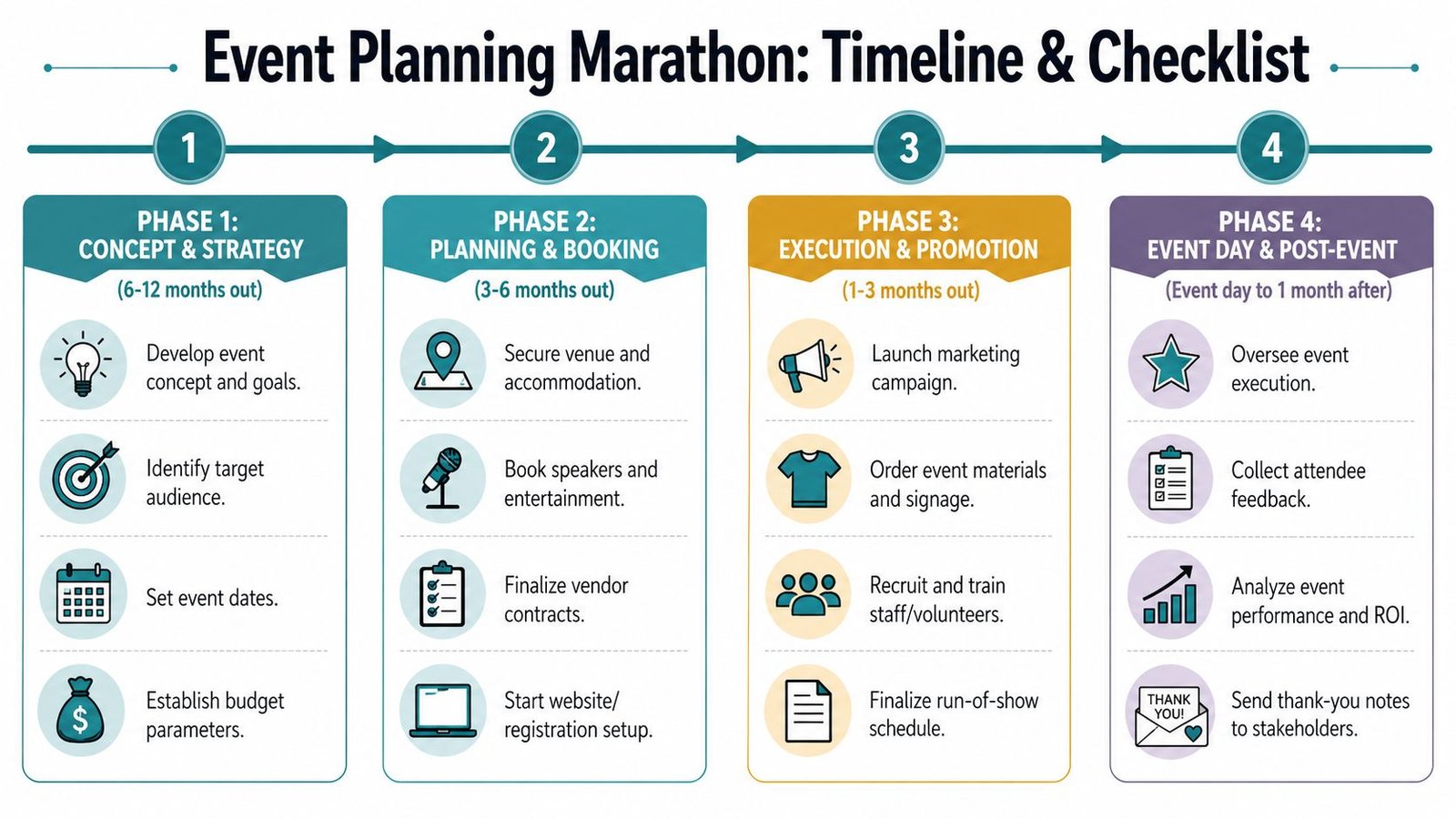
The most useful event timeline isn't the fanciest one. It's the one your team can use under pressure. Good corporate event planning breaks a complex project into phases that keep decisions timely and prevent last-minute panic from swallowing the experience.
This visual helps frame the overall sequence.
The timeline that keeps pressure manageable
Think of the process as four working phases rather than one giant to-do list.
Phase one is concept and strategy. This is when you confirm purpose, audience, dates, budget shape, and decision-makers. Don't rush this stage. It saves pain later.
Phase two is planning and booking. Secure the venue, room block, transport structure, key suppliers, and content architecture. If the event includes destination experiences, this is also the time to test whether those moments support the mandate or look attractive in a proposal.
Phase three is execution planning and promotion. Registration details, guest communications, signage, briefing documents, staffing, dietary tracking, rooming lists, AV coordination, and final run-of-show all live here. This phase is rarely glamorous, but it's where confidence is built.
Phase four is live delivery and follow-up. On-site management, issue handling, host presence, post-event feedback, internal debrief, and reporting all happen here. Don't make the mistake of treating the event ending as the project ending.
For planners building destination programs in Europe, this broader guide on planning a vacation to Europe is also useful for thinking through pace, regional movement, and traveler expectations.
A quick video overview can also help teams visualize the process before they dive into task lists.
A working checklist for the final stretch
As the date gets closer, detailed checks matter more than broad ideas. This is the list I'd keep visible:
- Confirm guest movement: Recheck arrivals, departures, transfer windows, and VIP handling.
- Lock the run of show: Finalize session timing, handoffs, room resets, and production cues.
- Brief every partner: Make sure suppliers know the event purpose, guest profile, and escalation path.
- Prepare host materials: Seating plans, contact sheets, dietary notes, speaker bios, and emergency scenarios.
- Walk the attendee lens: Test registration, signage, welcome flow, and transitions as if you were a guest.
- Protect the finale: Closing moments shape memory. Don't let the event drift out without intention.
- Schedule the debrief: Set the post-event review before the event begins, while everyone is still paying attention.
A final practical note. Leave white space in the program where you can. Not empty time for its own sake, but breathing room. If every minute is programmed, nothing can recover gracefully. The best-run events often feel relaxed because somebody worked very hard to create margin.
Corporate event planning is demanding because it asks for two kinds of excellence at once. Precision in logistics and generosity in experience. When both show up together, the result doesn't just run smoothly. It feels considered.
If you want a corporate event, retreat, or group journey that feels personal rather than packaged, La Sirena Vacations brings a boutique, concierge-style approach to planning in Spain, Argentina, and the Baltic States. Their team specializes in curated cultural experiences, private guided moments, and custom itineraries built with heart, local knowledge, and close attention to every detail.